Buyer’s guide · Supplier verification
When buyers compare overseas fabricators, steel structure company certifications can provide useful evidence about management systems, controles de soldadura, fabrication capability or market-specific conformity. Sin embargo, there is no single certificate that proves a company is automatically suitable for every warehouse, taller, factory or industrial steel project.
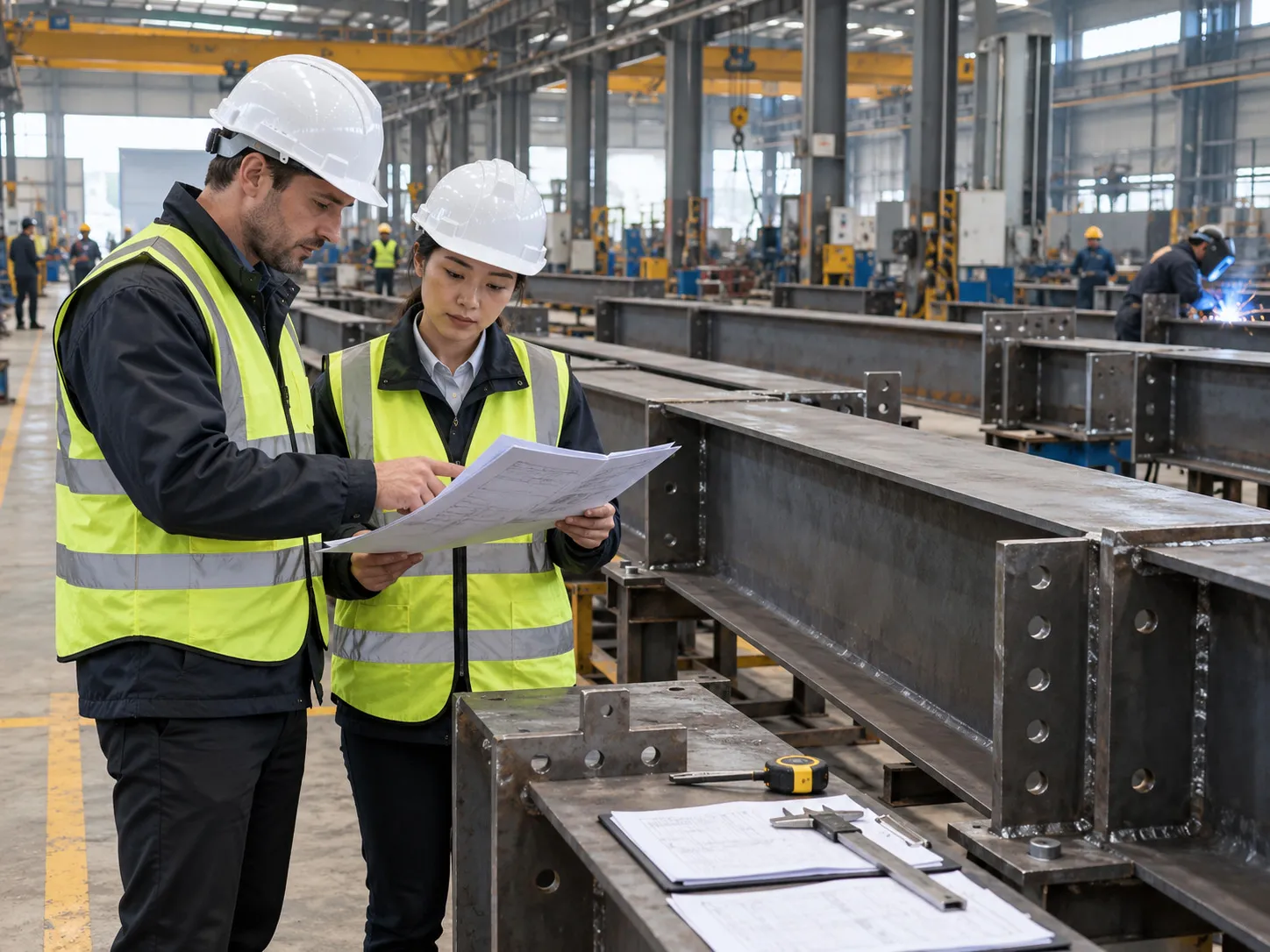
Certificates are useful evidence, but buyers should verify their scope, validity and relevance to the actual steel structure project.
The right certification package depends on the destination country, contract specification, structural code, welding requirements, execution class, inspection plan and whether the supplier is acting as a designer, fabricator, erector or complete building-package provider.
This guide explains the most common steel structure company certifications and related qualifications buyers may encounter, including ISO 9001, ISO 3834, AISC certification, European conformity requirements, welder qualifications and NDT personnel certification. It also explains which documents are genuine company-level certifications and which are instead project records, personnel qualifications or product-conformity documents.
For a broader supplier-selection process, ver nuestro guide to choosing a reliable steel structure supplier. For inspection controls during manufacturing, ver nuestro steel structure quality control guide.
01 / Certification guide
There Is No Universal List of Steel Structure Company Certifications
The first point for buyers to understand is that steel structure company certifications are not universal. A certificate that is important for one market may be optional or irrelevant in another.
Por ejemplo, a project in the United States may specify an AISC-certified fabricator and AWS welding requirements. A project in Europe may require conformity with the applicable Construction Products Regulation framework and relevant EN standards. Another project may only require an ISO 9001 quality-management system plus project-specific welding, inspection and material documentation.
Before asking a supplier for “all certificates,” buyers should identify:
- The destination country and local approval requirements.
- The structural design code and edition.
- The contractual fabrication standard.
- The welding code or welding-quality requirements.
- Any required fabricator certification program.
- Product-conformity or CE-marking requirements where applicable.
- Required welder and NDT personnel qualifications.
- Required material certificates and inspection records.
- Any environmental, occupational-health or client-specific management-system requirements.
02 / Certification guide
Quick Guide: Which Certifications and Qualifications Matter?
| Certification or document | What it relates to | When buyers should care |
|---|---|---|
| ISO 9001 | Company quality-management system | Useful baseline evidence for documented quality processes; often requested in supplier qualification |
| ISO 3834 | Quality requirements for fusion welding | Relevant where welding-quality management is contractually important or linked to regional fabrication requirements |
| AISC Certification | Fabricator, manufacturer or erector quality program | Important when the U.S. project specification requires the applicable AISC certification category |
| EN 1090 / CE-related conformity | Structural component conformity and factory production control in applicable European supply | Relevant where the product and market fall under applicable EU construction-product requirements |
| ISO 14001 | Environmental-management system | Useful when owners, EPC contractors or procurement policies require environmental-management evidence |
| ISO 45001 | Occupational health and safety management system | Useful when safety-management systems are part of supplier prequalification |
| Welder qualification | Individual welder competence for defined process/range | Needed when required by the welding code or contract; it is not a company certification |
| WPS / PQR or WPQR | Qualified welding procedure | Important for demonstrating that the required weld procedure has been established and qualified |
| NDT personnel certification | Qualification of inspection personnel | Important when UT, MT, PT, RT or other NDT is specified |
| Mill test certificate | Material properties and traceability | Important when material certification is required; it is not a company certification |
03 / Certification guide
1. ISO 9001: Quality-Management System Certification
Among steel structure company certifications, ISO 9001 is one of the most widely recognized starting points. It is a quality-management-system standard rather than a structural-design or welding code.
An ISO 9001-certified company should have documented processes for matters such as responsibilities, document control, purchasing, producción, nonconformance handling, corrective action and continual improvement. This can be useful when a buyer wants evidence that the factory operates under an organized quality-management framework.
Sin embargo, ISO 9001 does not by itself prove that a steel frame has been designed correctly, that a particular weld meets AWS or EN requirements, or that every member has passed project-specific inspection.
ISO is updating the standard in 2026. Buyers should therefore verify the exact edition shown on the certificate and the applicable transition status through the official ISO 9001 information rather than assuming that every certificate showing an older edition remains valid indefinitely.
What to Verify on an ISO 9001 Certificate
- Exact legal company name.
- Factory or site covered by the certificate.
- Scope of certification.
- Standard and edition.
- Certificate number.
- Certification body.
- Issue and expiry dates.
- Accreditation information where applicable.
- Whether the certification scope actually includes structural-steel fabrication or relevant manufacturing activities.
A certificate covering only “trading services” should not be treated as equivalent to a certificate whose scope includes structural-steel fabrication.
04 / Certification guide
2. ISO 3834: Welding Quality Requirements
Welding is a special process in structural-steel fabrication because the final quality cannot always be confirmed only by looking at the finished weld. For projects with significant welding requirements, buyers may therefore encounter ISO 3834.
ISO 3834-1:2021 provides criteria for selecting an appropriate level of quality requirements for fusion welding of metallic materials. The series includes different quality levels rather than one universal requirement for every fabricator.
ISO 3834 can be relevant to steel structure company certifications where the owner, regional standard or contract requires a documented welding-quality system. Buyers should still confirm which part or quality level applies to the project.
Important welding-control subjects can include:
- Welding procedure specifications.
- Procedure qualification records.
- Welder and welding-operator qualifications.
- Welding coordination responsibilities.
- Base-material and consumable control.
- Joint preparation and fit-up.
- Preheat and interpass-temperature requirements.
- Inspection and NDT requirements.
- Repair procedures.
- Traceability and fabrication records.
Nuestro structural steel fabrication process guide explains how drawing control, material preparation, asamblea, soldadura, inspection and surface treatment connect during production.
05 / Certification guide
3. Do Not Confuse Welding Codes and Welder Qualifications with Company Certification
One of the most common procurement mistakes is to treat every welding document as a company certificate.
Por ejemplo, AWS D1.1/D1.1M is a structural welding code for steel. It is not a generic certificate issued to a company simply because the company states that it follows AWS.
Similarly, a welder qualification demonstrates that a particular person has passed a qualification test for a defined process and range. ISO states that ISO 9606-1 specifies qualification testing of welders for fusion welding of steels.
Depending on the applicable code, buyers may need to review:
- WPS: Welding Procedure Specification.
- PQR or WPQR: procedure qualification documentation.
- Welder qualification certificates.
- Welding-operator qualifications for mechanized processes where required.
- Continuity or validity records.
- Welding consumable certificates.
- NDT and final weld-inspection records.
06 / Certification guide
4. AISC Certification for Projects That Require It
For U.S.-specified projects, one of the most recognized steel structure company certifications is AISC Certification when the contract requires an applicable certified fabricator, manufacturer or erector.
AISC explains that its certification programs evaluate whether participants have the personnel, organization, experience, procedures, knowledge and equipment needed for the relevant fabrication, manufacturing or erection scope. As of 2026, AISC lists AISC 207-25 as the current Certification Standard and provides supplemental requirements for different program categories.
Buyers should not simply ask, “Are you AISC certified?” They should verify:
- The exact certified company name.
- The certified facility.
- The certification category.
- Any endorsements required by the project.
- Current certification status.
- Whether the project specification actually requires AISC Certification.
The official AISC Certified Fabricators resources and certification search can be used to verify participating companies.
Not every international steel building needs AISC Certification. A warehouse project designed to another national standard should not automatically be rejected because the fabricator does not hold a certification that the contract never required.
07 / Certification guide
5. European Projects: EN 1090, Factory Production Control and CE Marking
For structural components supplied into Europe, buyers may need to evaluate conformity requirements under the applicable EU Construction Products Regulation framework and relevant harmonised technical specifications.
This area should not be simplified into the statement “the company has CE certification.” CE marking is a product-conformity marking linked to declared product performance and the applicable regulatory framework; it is not a universal company-quality certificate.
The European Commission explains that the Construction Products Regulation establishes harmonised rules for construction products and links CE marking to declaration-of-performance and conformity requirements.
Where EN 1090-related requirements apply to fabricated structural components, buyers may need to confirm matters such as:
- Applicable product and harmonised technical specification.
- Factory Production Control scope.
- Notified-body involvement where required.
- Declaration of Performance or other required conformity documentation.
- CE marking requirements.
- Execution class.
- Welding-quality requirements.
- Material and traceability requirements.
EU construction-product rules are undergoing a regulatory transition under the revised CPR framework, so buyers should confirm the current legal and project requirements for the specific product at the time of procurement rather than relying on an old checklist.
08 / Certification guide
6. ISO 14001 and ISO 45001: Useful Management-System Certifications
Some owners and EPC contractors include environmental and occupational-health requirements in supplier prequalification. In those cases, two additional steel structure company certifications may be relevant.
ISO 14001: Environmental Management
ISO 14001 addresses environmental-management systems. It can provide evidence that a company has a structured approach to environmental responsibilities such as waste, emissions, resource use and compliance processes.
It is useful in corporate or project prequalification, but it does not replace structural design, welding or fabrication requirements.
ISO 45001: Occupational Health and Safety
ISO 45001 specifies requirements for an occupational health and safety management system. Para compradores, it may provide supporting evidence that the organization manages workplace health and safety risks through a documented system.
Again, ISO 45001 is not proof that a specific steel member complies with the project drawings. It should be evaluated as part of the supplier’s management-system profile.
09 / Certification guide
7. NDT Personnel, Material Certificates and Inspection Reports Are Different Documents
A steel structure project usually needs more than company-level certificates. Buyers should distinguish steel structure company certifications from personnel qualifications, material certificates and project inspection records.
NDT Personnel Certification
When non-destructive testing is specified, the competence of the person performing or interpreting the test can be important. ISO 9712:2021 specifies requirements for qualification and certification of NDT personnel for methods such as ultrasonic, magnetic, penetrant and radiographic testing.
The project specification may instead reference another recognized personnel-qualification scheme. Buyers should verify the method, level, scope and validity required by the contract.
Material Certificates
Mill test certificates or inspection certificates document material properties. They are evidence relating to the steel supplied, not certification of the fabricator itself.
Where traceability is required, certificates should be connected to identifiable plates, sections or production records rather than supplied as unrelated paperwork.
Project Inspection Reports
Dimensional reports, weld-inspection records, informes de END, coating-thickness readings and final inspection documents provide evidence about the actual project. In many cases, these records are more important to the finished building than a general company brochure listing certificates.
10 / Certification guide
8. How to Verify Steel Structure Company Certifications
Buyers should verify steel structure company certifications before relying on them in a purchasing decision. A PDF certificate sent by email should be treated as a starting point, not the end of the verification process.
Use the following checklist:
- Match the legal entity. The company name on the certificate should correspond to the company signing the contract or clearly identify the relationship.
- Check the certified site. Confirm whether the certificate covers the actual fabrication factory.
- Read the scope. Make sure the scope includes relevant manufacturing or fabrication activities.
- Check the standard and edition. Standards are revised. An old edition may be in transition, superseded or no longer current.
- Check dates. Review issue, surveillance and expiry information.
- Identify the certification body. Confirm who issued the certificate.
- Check accreditation where relevant. Understand whether the certification body is accredited for the relevant scheme.
- Use official directories. Where the scheme provides an official search tool, verify the company independently.
- Check certificate status. A certificate can be suspended, withdrawn, expired or limited in scope.
- Compare the certificate with project requirements. A genuine certificate can still be irrelevant to your project.
Do Not Verify Only by Logo
Website logos can be copied, outdated or displayed without enough context. Ask for the certificate number and scope, then verify independently where possible.
11 / Certification guide
Certification Red Flags Buyers Should Investigate
The following issues do not automatically prove that a supplier is unsuitable, but they justify further review:
- The certificate company name does not match the contracting entity.
- The factory address is different from the certified site with no explanation.
- The scope covers trading but not fabrication.
- The certificate is expired.
- The supplier sends only a cropped logo or screenshot.
- The certificate number cannot be verified.
- The supplier claims “AWS certified company” without explaining what is actually certified or qualified.
- The supplier presents a welder certificate as proof of company certification.
- The supplier presents material test certificates as a quality-management certificate.
- The certification applies to a different subsidiary or factory.
- The supplier cannot provide project-specific welding or inspection records despite displaying many certificates.
- The certificate is genuine but unrelated to the destination market or project specification.
12 / Certification guide
9. Certification Expectations by Project Type and Market
| Project situation | Documents or certification areas to review | Buyer note |
|---|---|---|
| General overseas industrial building | ISO 9001, welding qualifications, certificados de materiales, project QC records | Confirm contract requirements rather than assuming one global standard |
| U.S.-specified structural project | AISC Certification if specified, AWS D1.1 requirements, applicable material and inspection records | Verify exact AISC category and governing project documents |
| European structural component supply | Applicable EN 1090/CPR conformity, FPC, CE-related documents, welding qualifications | Confirm current regulatory route and execution requirements |
| High-welding-demand industrial structure | ISO 3834 where specified, WPS/PQR or WPQR, welder qualifications, NDT | Welding control may be more important than a generic management certificate |
| Owner with ESG or HSE prequalification | ISO 14001, ISO 45001 and client-specific requirements | These support management-system evaluation, not structural compliance |
| Project with critical weld inspection | Qualified NDT personnel, approved procedures and project inspection reports | Verify method, level, coverage and acceptance criteria |
13 / Certification guide
10. Certifications Do Not Replace Fabrication Quality Control
Even valid steel structure company certifications should be combined with project-specific technical review.
A buyer should still confirm:
- Design basis and structural code.
- Approved drawings and revision control.
- Grados de materiales.
- Connection details.
- WPS and welder qualifications where required.
- Specified NDT.
- Dimensional tolerances.
- Surface preparation and coating system.
- Roof and wall material specifications.
- Piece marking and packing.
- Pre-shipment inspection.
- Erection drawings and technical support.
Nuestro steel structure quality control guide explains how material inspection, controles de soldadura, dimensional checks, NDT and coating inspection can be organized during fabrication.
For protective coatings and galvanizing, ver nuestro steel structure surface treatment guide. For overseas logistics, ver nuestro steel building packing and shipping guide.
14 / Certification guide
What Certification Information Should Buyers Request in an RFQ?
Instead of writing “supplier must have international certification,” include a specific document list in the RFQ.
Depending on the project, request:
- ISO 9001 certificate and scope.
- ISO 3834 certificate where required.
- AISC certificate and category where specified.
- Applicable EN 1090 / FPC / CE conformity documents where required.
- ISO 14001 or ISO 45001 where required by client policy.
- Welder qualification records.
- WPS and procedure qualification records.
- NDT personnel qualifications.
- Certificados de materiales.
- Quality plan or Inspection and Test Plan.
- Project-specific inspection reports.
- Third-party inspection requirements.
- Document language and submission schedule.
Nuestro steel building design requirements guide can also help buyers prepare the technical information needed before requesting a steel-building quotation.
15 / Certification guide
How Bingfa Steel Structure Approaches Certification and Project Documentation
Certification requirements vary by country and project, so buyers should not assume that one fixed certificate package applies to every steel building.
Bingfa Steel Structure supplies prefabricated steel buildings and industrial steel structures for overseas projects. During technical review, buyers should identify the required structural standard, welding requirements, inspection scope, material documentation and any required company or project certifications before production begins.
Where a project specifies particular certifications or third-party documentation, those requirements should be reviewed against the agreed supply scope before order placement.
Certificate Check
- Legal company name
- Certified factory location
- Certification scope
- Standard and edition
- Certificate number
- Issuing body
- Validity dates
- Official directory status
- Project relevance
Verify certificates against the actual contract scope and destination-market requirements.
Preguntas frecuentes
What are the most important steel structure company certifications?
There is no universal list. ISO 9001 is a common quality-management certification, while ISO 3834 may be relevant to welding-quality management. AISC Certification may be required for certain U.S.-specified projects, and European projects may involve EN 1090 and Construction Products Regulation conformity requirements. The contract and destination market should determine what is necessary.
Does every steel structure company need ISO 9001?
No universal rule requires every steel structure company worldwide to hold ISO 9001. Sin embargo, many buyers use ISO 9001 as useful supplier-prequalification evidence because it addresses a documented quality-management system. Project-specific fabrication controls are still required.
Is AWS D1.1 a company certification?
No. AWS D1.1 is a structural welding code for steel. A project may require welding procedures, welder qualifications and inspections that comply with AWS D1.1, but saying that a company is simply “AWS certified” does not describe the exact welding qualification or certification status.
Does a welder certificate prove the factory is certified?
No. A welder qualification relates to an individual welder and a defined qualification range. It does not replace a company-level quality-management certificate or a fabricator certification program.
Does a U.S. steel project always require AISC Certification?
No. AISC Certification should be required when the project specification, owner, authority or procurement requirements call for the applicable certification. Buyers should review the contract documents and verify the exact certification category.
What certification is needed to supply structural steel to Europe?
The answer depends on the product, uso previsto, current regulatory framework and applicable harmonised technical specification. Structural-component supply may involve EN 1090-related factory production control and CE-marking requirements under the applicable Construction Products Regulation framework. Buyers should confirm the current legal and project requirements for the specific product.
How do I verify a steel structure certificate?
Check the legal entity, factory address, scope, standard, edition, certificate number, issuing body, dates and status. Where an official certification directory is available, verify the certificate independently instead of relying only on a PDF or website logo.
Are ISO 14001 and ISO 45001 structural-quality certifications?
No. ISO 14001 relates to environmental management, while ISO 45001 relates to occupational health and safety management. They can be useful in supplier prequalification but do not prove structural design or fabrication compliance.
Are material certificates the same as company certifications?
No. Material certificates document the properties or inspection status of supplied steel. They are project or material records and should be linked to the actual material when traceability is required.
Review your project documentation
Need help reviewing steel structure company certifications for an upcoming warehouse, taller, fábrica o proyecto industrial? Contacto Estructura de acero Bingfa with your project country, applicable standard, building requirements, drawings and certification requirements. We can review the requested documentation together with the technical supply scope.
Send a project enquiry ↑Teléfono / WhatsApp: +86 19006726230
Correo electrónico: bingfasteelstructure@gmail.com