Tratamiento superficial de estructura de acero: Blasting, Painting and Galvanizing Explained
Steel structure surface treatment influences corrosion risk, coating adhesion, requisitos de inspección, acceso de mantenimiento, and the long-term cost of a building. Yet quotations often reduce the subject to a color name or a short phrase such as “one coat of primer.” Those descriptions do not establish how the steel will be cleaned, what system will be applied, or how compliance will be verified.
A lower finishing price can become expensive when hidden exclusions lead to premature coating failure, field repairs, or operational shutdowns. Buyers should compare the complete sequence from surface preparation through final inspection—not only the visible finish.
This guide explains abrasive blasting, protective painting, hot-dip galvanizing, and duplex systems. It is intended for contractors, project owners, equipos de adquisiciones, and engineers involved in international steel building projects who need to evaluate fabrication proposals and select a suitable corrosion-protection system for their project environment and applicable standards.
What Does Steel Structure Surface Treatment Include?
The term covers the operations used to clean, prepare, protect, and verify a steel surface. Preparation may include solvent cleaning, hand or power-tool cleaning, abrasive blasting, or another specified method. Protection may be an organic paint system, a metallic zinc coating, o una combinación. Inspection connects the specification to the delivered work.
Blasting and coating are not interchangeable steps. Blasting produces a defined level of cleanliness and surface profile; by itself, it normally does not provide durable atmospheric corrosion protection. Paint isolates steel from the environment. Hot-dip galvanizing forms a bonded zinc coating that provides barrier and sacrificial protection. The right tratamiento superficial de la estructura de acero therefore depends on exposure, geometría, construction sequence, apariencia, and maintenance strategy.
Abrasive Blasting and Steel Surface Preparation
Abrasive blasting propels media against steel to remove mill scale, rust, old coating, and other material while creating an anchor profile. Shot blasting in an enclosed machine commonly suits repetitive steel members; open or manual blasting can reach shapes that automated equipment cannot process. “Sandblasting” is often used as a general term, but the actual abrasive, equipo, containment, and worker controls must be specified.
Cleanliness Is a Defined End Condition
Statements such as “fully blasted” are not objective acceptance criteria. AMPP maintains surface-preparation standards covering solvent cleaning, commercial blast, near-white metal blast, white metal blast, industrial blast, power-tool cleaning, waterjetting, and related methods. Its surface-preparation standards overview identifies the relevant standard families.
The selected grade should match the coating manufacturer’s requirements and the service environment. A more intensive blast is not automatically a better purchasing decision if the coating system does not require it, but an insufficient grade can undermine adhesion and durability.
Profile, Dust, and Soluble Contamination Matter
Visual cleanliness is only part of preparation. The coating system also needs a suitable surface profile. Excessive profile can leave peaks insufficiently covered; inadequate profile can reduce mechanical adhesion. Dust, aceite, moisture, and soluble salts may remain even when steel looks clean. The inspection plan should identify the required tests, instrumentos, sampling frequency, and acceptance limits.
Prepared Steel Has a Limited Coating Window
Freshly blasted steel can rust quickly when exposed to moisture. Humidity, steel temperature, dew point, time before priming, and handling must be controlled. The production plan should connect blasting and coating capacity so cleaned members do not wait unprotected. Abrasive blasting also creates dust, ruido, and material hazards; OSHA abrasive blasting safety fact sheet explains why engineering controls, respiratory protection, hearing protection, and hazard assessment matter.
Protective Paint Systems for Structural Steel
A protective paint specification normally identifies substrate preparation, cebador, capa intermedia, topcoat, nominal dry-film thickness for each layer, environmental limits, recoat windows, application method, repair procedures, e inspección. Generic labels such as “red oxide primer” do not provide enough information to compare performance.
Primer, Build Coat, and Topcoat Have Different Jobs
The primer promotes adhesion and begins corrosion protection. An intermediate coat can build thickness and reinforce the barrier. The topcoat supplies weathering resistance, color, and cleanability where required. Not every project needs three coats, and the same product family is not suitable for every atmosphere or immersion condition. Select the complete system for the stated exposure.
Application Conditions Affect the Result
Spray, rodillo, and brush application can all have appropriate uses, but edges, soldaduras, pernos, recesses, and difficult geometries deserve special attention. Stripe coats may be specified at vulnerable details. Applicators should record ambient temperature, relative humidity, surface temperature, and dew point as required by the product data sheet.
Wet-film and dry-film measurements serve different purposes. Final dry-film thickness should be evaluated using the specified procedure and sampling plan rather than one convenient reading. AMPP’s structural steel coating guidance emphasizes matching surface preparation, solicitud, and coating choice to the environment.
Hot-Dip Galvanizing for Structural Steel
For after-fabrication hot-dip galvanizing, completed members are chemically cleaned, fluxed, immersed in molten zinc, withdrawn, cooled, and inspected. Zinc reacts with the steel to form bonded alloy layers. Where the process can reach, both external and internal surfaces of properly vented hollow members may be coated.
In the U.S., ASTM A123/A123M commonly applies to fabricated structural-steel products. Other product types, including certain hardware, can fall under different specifications. The purchase order should identify the correct standard for each component instead of using “galvanized” as the only acceptance statement.
Design for Immersion Before Cutting Steel
Assemblies need galvanizer-approved venting and drainage, suitable lifting points, and dimensions compatible with handling and kettle capacity. Overlapping surfaces, sealed cavities, mixed thicknesses, and asymmetrical fabrication can affect safety, coating access, or distortion risk. Resolve these details during drawing review. Nuestro galvanized steel structures guide explains design, inspección, almacenamiento, and repair considerations in more depth.
Appearance Variation Is Not Automatically a Defect
Galvanized surfaces can be bright, dull, or mottled because steel chemistry, enfriamiento, geometría, and processing affect the zinc reaction. Inspection should address coating coverage, espesor, finalizar, repairs, and fit for use. A uniformly shiny surface is not proof of compliance, and normal visual variation is not necessarily failure.
De un vistazo: Blasting, Painting, and Galvanizing
| Decision factor | Abrasive blasting | Protective painting | Hot-dip galvanizing |
|---|---|---|---|
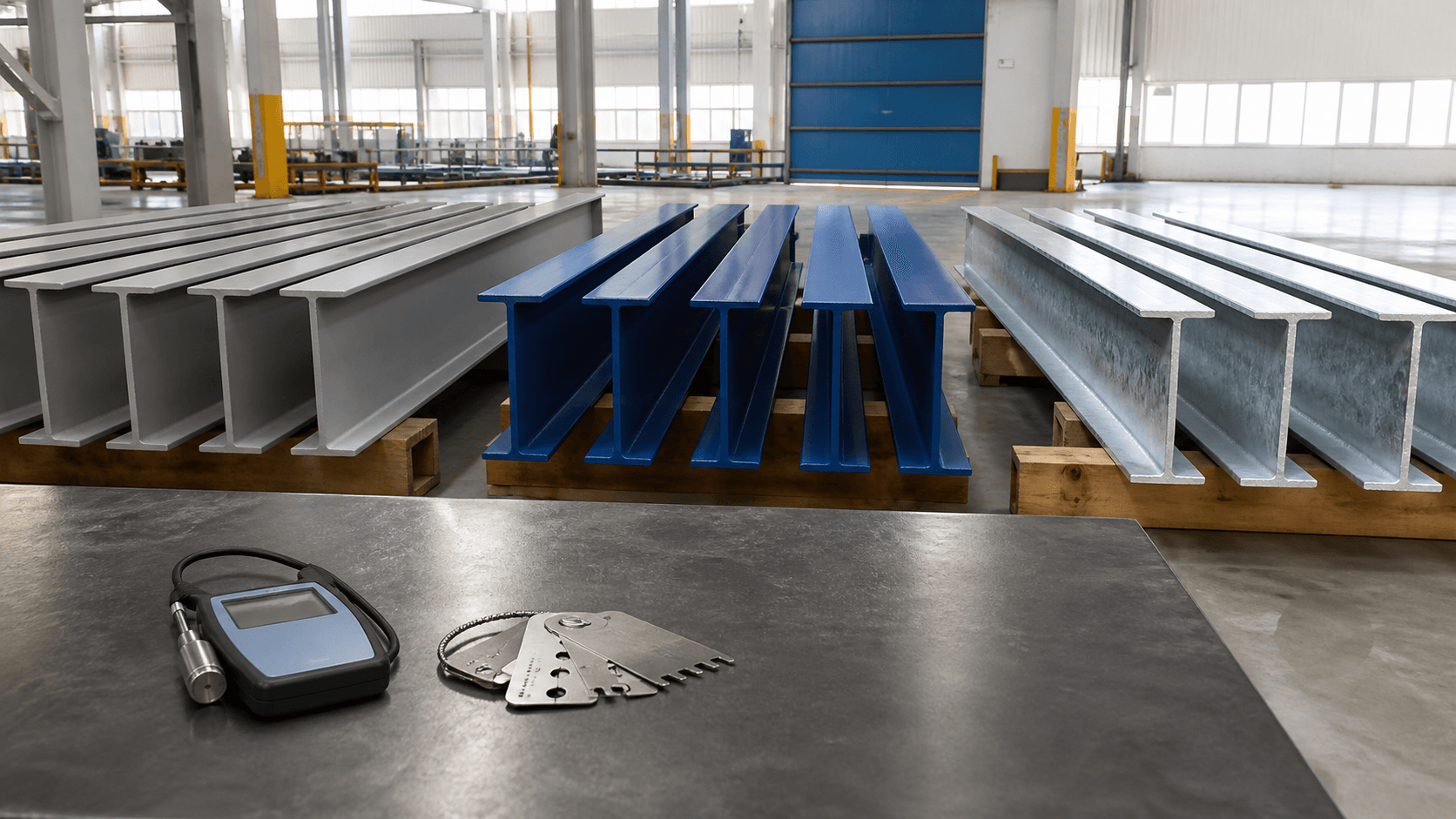
| Primary purpose | Clean and profile the substrate | Create a specified barrier coating system | Apply bonded zinc barrier and sacrificial protection |
| Is it a complete protection system? | No, normally a preparation step | Sí, when the full system is specified and applied | Sí, for suitable components and exposure |
| Main design interface | Access, containment, profile, and coating timing | Edges, acceso, curación, color, and recoat windows | Venting, drenaje, immersion size, and distortion control |
| Typical inspection | Cleanliness, profile, polvo, and specified contaminants | Preparation, condiciones, espesor de película seca, cure, and defects | Coverage, coating thickness, finalizar, repairs, and fit |
| Appearance options | Temporary bare-metal appearance | Broad color and gloss choices | Natural silver-to-gray zinc variation |
| Field maintenance | Not applicable as a finish by itself | Localized repair and scheduled recoating may be required | Repair damaged areas with an approved method; exposure matters |
The three columns are not direct substitutes: blasting is usually part of a painted system, while galvanizing has its own preparation and acceptance process.
When Should Buyers Consider a Duplex System?
A duplex system applies paint or powder coating over hot-dip galvanizing. It may be evaluated when a project needs a defined color, additional barrier protection, or a maintenance strategy that retains zinc beneath the topcoat. The benefits depend on compatible materials, correct preparation, and actual exposure; they should not be reduced to a universal service-life multiplier.
Newly galvanized steel is not simply painted like blasted carbon steel. Cleaning, removal of high spots, surface profiling, post-treatment compatibility, product selection, and timing must be coordinated. ASTM D6386 provides a preparation practice for painting galvanized surfaces, and the American Galvanizers Association’s duplex coating guidance discusses these procedures.
What Separates a High-Quality Surface Treatment?
A quality supplier translates the project environment into an auditable specification. The proposal states preparation grade, abrasive or cleaning method, profile range where applicable, named coating products, layer sequence, thickness criteria, application conditions, repair rules, and inspection records. Member identification connects those records to the shipped steel.
Ordinary proposals may quote only a finish name, nominal total thickness, or color. That leaves buyers unable to determine whether two prices include the same work. Para tratamiento superficial de la estructura de acero, measurable requirements and documented hold points are more useful than marketing descriptions.
Key Factors When Selecting the Protection System
Begin with the actual environment: indoor dryness, condensación, industrial contaminants, sales costeras, soil or water contact, chemical exposure, temperatura, and sheltered surfaces. Then consider maintenance access, expected appearance, fire-protection interfaces, transport damage, bolted or welded connections, and whether field modification is likely.
Do not select a system from building type alone. Two warehouses in different microclimates can need different protection, while exterior and interior members on one project may justify different specifications. The corrosion specialist, ingeniero estructural, coating manufacturer, fabricator, and galvanizer should resolve interfaces before release.
Which Details Affect Cost and Schedule?
Surface area, member geometry, cleanliness grade, profile, coating layers, cure time, color changes, masking, inspección, galvanizing kettle limitations, transport between facilities, and repair scope can all affect price. Schedule also depends on approved drawings, material release, blast or galvanizing capacity, environmental conditions, quality hold points, embalaje, y secuencia de entrega.
Compare suppliers on a consistent scope. Confirm whether the price covers preparation, revestimiento de rayas, every layer, pruebas, reports, touch-up materials, packaging protection, transporte, y reparación de campo. Nuestro guía del proceso de fabricación de acero estructural shows where finishing fits within the wider production sequence.
Documents to Request Before Shipment
- Approved coating or galvanizing specification and product data sheets.
- Surface-preparation and environmental-condition records where applicable.
- Surface-profile and dry-film thickness results tied to inspected lots.
- Galvanizing inspection records and component identification where specified.
- Nonconformance, reparar, and reinspection records.
- Color, embalaje, member-marking, and field touch-up instructions.
Documentation requirements should appear in the purchase order, not be requested for the first time at dispatch. Define the sampling plan, responsible inspector, acceptance criteria, and release authority early enough to avoid disputes.
Specify the Complete Steel Structure Surface Treatment
The best tratamiento superficial de la estructura de acero is the system that fits the exposure, geometría, apariencia, construction sequence, and maintenance plan—and can be verified. Blasting prepares a substrate, paint provides a designed barrier, galvanizing adds zinc protection, and a duplex system combines zinc with a compatible topcoat.
Need to compare finishing options for a warehouse, taller, or industrial frame? Contacto Estructura de acero Bingfa con la ubicación de su proyecto, dibujos, exposición, appearance requirements, and preferred standards to discuss a project-specific fabrication proposal and quotation.
Preguntas frecuentes
What is the best steel structure surface treatment?
No existe un mejor sistema universal. Evaluate exposure, access for maintenance, apariencia, component geometry, construction sequence, and project standards. A project may use paint, galvanizado, a duplex system, or different systems in different zones.
Is sandblasting the same as shot blasting?
Both terms describe abrasive impact used for cleaning or profiling, but the media and equipment can differ. Shot blasting often refers to recyclable metallic media in enclosed machinery. The purchase order should state the required cleanliness and profile rather than relying on a process nickname.
How long do painted and galvanized coatings last?
Service and maintenance intervals depend on coating thickness, selección del sistema, workmanship, exposición, detallando, damage, y mantenimiento. Ask for an environment-specific basis and inspection plan instead of accepting a fixed number of years without assumptions.
Can hot-dip galvanized steel be painted?
Sí. Paint or powder coating over galvanized steel creates a duplex system, but the zinc surface needs compatible cleaning, profiling, productos, and application timing. Specify the complete system before work begins.
What surface-treatment documents should a fabricator provide?
Dependiendo del sistema, request the approved specification, product data, preparation and environmental records, profile or thickness measurements, inspection results, repair records, and traceability to the shipped members.