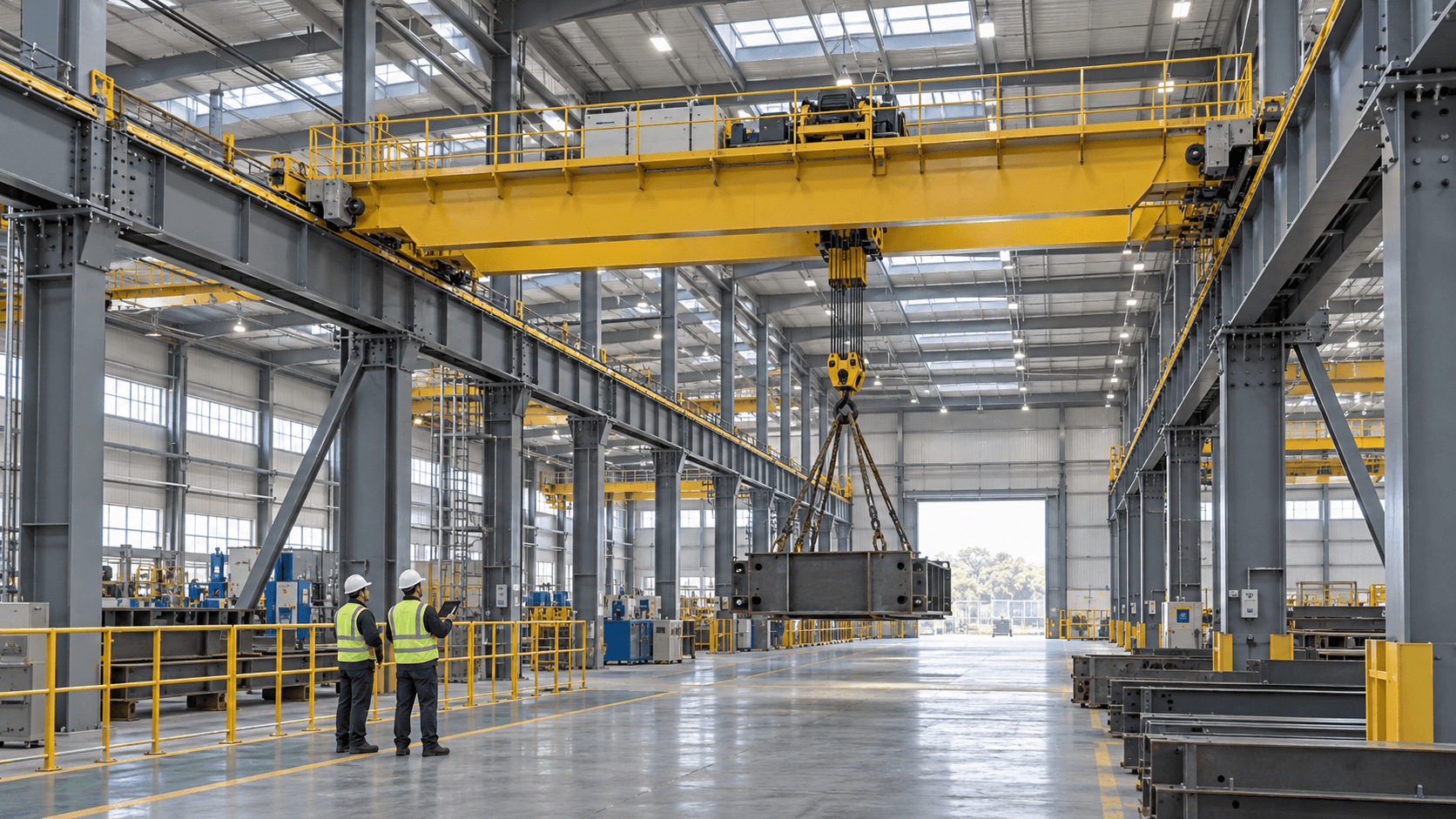
An industrial crane runway steel structure does more than support a rail. It transfers repeated wheel loads, horizontal crane forces, braking effects, and building reactions into the columns and foundations while keeping the rails aligned for smooth crane travel. If the runway is too flexible, poorly detailed, or fabricated outside tolerance, the result can be wheel wear, rail damage, vibración, production interruptions, and costly field correction.
For plant owners and procurement teams, comparing runway suppliers only by steel weight or price per tonne gives an incomplete picture. Crane class, rated capacity, durar, duty cycle, wheel arrangement, hook approach, operating environment, and future production plans all affect the right solution. This product guide explains the principal design decisions, controles de fabricación, deliverables, and commercial factors buyers should evaluate before ordering a crane runway system.
Industrial Crane Runway Steel Structure at a Glance
| Design item | Project-specific requirement |
|---|---|
| Typical applications | Fabrication bays, foundries, maintenance halls, assembly plants, power facilities, almacenes, and heavy equipment workshops |
| Primary components | Runway girders, rails, brackets or columns, vigorizante, end stops, access platforms, conexiones, and anchor systems |
| Input data | Crane capacity, crane span, cargas de ruedas, wheel spacing, crane class, travel speed, rail type, building geometry, and governing code |
| Fabrication scope | Dibujos de tienda, corte, perforación, soldadura, trial checks, surface protection, identification, embalaje, and quality records |
| Available protection | Project-specified paint systems or galvanizing where geometry, service conditions, and local requirements permit |
Where Crane Runway Systems Are Used
An industrial crane runway steel structure is used wherever an overhead bridge crane must move loads along a defined production route. In a fabrication shop, it may serve plate handling, estaciones de soldadura, and dispatch. In a maintenance facility, it may lift engines or process equipment. In a warehouse, it can handle coils, dies, or long products that are difficult to move with forklifts. The operational purpose changes, but the structural requirement remains the same: predictable load transfer with stable geometry.
The runway may be supported on independent columns, on brackets connected to the main building columns, or as part of a purpose-designed industrial frame. Each arrangement changes the forces applied to the building. When a crane is added to a new workshop, the runway and the main structure should be engineered together. For an existing building, the original drawings, actual member sizes, foundation capacity, and measured geometry must be verified before loads are introduced.
8 Design Priorities for a Reliable Crane Runway
1. Establish the Crane Design Basis
The engineering team needs the crane manufacturer’s data before sizing an industrial crane runway steel structure. Rated capacity alone is not enough. Cargas de ruedas, wheel spacing, bridge self-weight, trolley position, durar, rail section, buffer forces, travel speed, service class, and allowable tolerances must be confirmed. The governing national standard and project specification should also be stated in the contract documents.
For projects using American practice, the engineer may reference the Especificación AISC para edificios de acero estructural for structural steel requirements and an applicable crane standard for operating loads. Other countries may require Eurocodes, Australian Standards, or local regulations. A competent supplier should work to the engineer-of-record’s approved basis rather than substitute a familiar standard without review.
2. Calculate Vertical, Lateral, and Longitudinal Actions
Crane wheels create concentrated moving loads that can govern girder bending, web strength, fatiga, and support reactions. The analysis also includes impact or dynamic allowance, transverse forces caused by trolley movement and skewing, and longitudinal forces from crane acceleration, braking, and contact with end stops. Load combinations must include relevant building actions such as wind, efectos sísmicos, and temperature.
An industrial crane runway steel structure should be checked in the most unfavorable crane positions, not only with the bridge centered in the bay. Where two cranes share a runway, the specified probability and spacing of simultaneous operation can materially change column and foundation reactions.
3. Control Deflection and Vibration
Strength prevents failure, but serviceability determines how well the crane operates. Excessive vertical deflection can affect rail level; lateral movement can contribute to wheel flange contact, skewing, and uneven wear. Repetitive acceleration may also create vibration that interferes with precision lifting or nearby equipment.
Allowable limits should be agreed with the crane supplier and structural engineer because they depend on crane class and use. Deeper girders, closer column spacing, lateral bracing, or stiffer moment connections may be justified even when a lighter section passes a basic strength check. This is one reason the lowest-weight proposal is not always the lowest-life-cycle-cost option.
4. Detail the Rail and Girder Interface
Rail selection influences the girder flange, fastening system, alignment method, and maintenance procedure. Clips may need adjustment capacity; pads can distribute contact and reduce local effects; joints require coordinated positioning. Rail welds, bolted joints, and end stops must match the crane supplier’s requirements.
The top flange and web beneath the rail experience localized stresses as the wheels pass. Stiffeners, cap plates, and weld details should therefore be designed as a system. For an industrial crane runway steel structure, small dimensional errors at this interface can cause a large operational consequence, so fabrication and survey tolerances must be clearly documented.
5. Design Connections for Repeated Loading
Connections in an industrial crane runway steel structure transfer vertical reactions and horizontal forces while allowing the behavior assumed by the engineer. Brackets, seats, column attachments, splice plates, bracing nodes, and end-stop details require explicit checks. Weld termination, abrupt section changes, and attachment geometry deserve particular attention where fatigue is relevant.
Shop-welded and site-bolted assemblies can reduce erection time, but shipping limits and access for bolt tightening must be considered during detailing. Connection drawings should identify bolt grade, hole type, weld size, weld process, inspection requirement, and any surfaces that must remain unpainted for slip-critical joints.
6. Coordinate Columns, Bracing, and Foundations
Runway loads do not stop at the girder. Brackets and columns must resist eccentric reactions, local flange or web forces, and frame drift. Bracing carries longitudinal actions to the foundations, while anchor rods and concrete bases complete the load path. If the runway connects to the building frame, both systems need compatible stiffness and movement assumptions.
Buyers should provide geotechnical data, finished floor level, autorizaciones de equipos, and foundation constraints early. nuestra guía para steel building design requirements explains why complete project inputs reduce revisions. Missing foundation information can delay approval even when fabrication drawings are otherwise complete.
7. Plan Access, Protección, and Maintenance
Safe access may require walkways, ladders, escaleras, guardrails, maintenance platforms, and fall-protection provisions. Clearances must account for the crane bridge, electrical conductors, building bracing, roof members, lights, sprinklers, and process services. Maintenance access should be designed before the steel is released, not improvised after installation.
Corrosion protection depends on environmental exposure and maintenance strategy. El ISO 12944 framework provides internationally recognized guidance for protective paint systems on steel structures. Surface preparation, espesor de película seca, edge treatment, color, repair procedures, and inspection records should be stated. See our practical overview of tratamiento superficial de la estructura de acero for procurement questions covering blasting, painting, and galvanizing.
8. Build Inspection into Fabrication and Erection
The quality plan for an industrial crane runway steel structure should trace material certificates to member marks and define hold points for dimensions, soldadura, nondestructive testing, preparación de la superficie, and coating. Runway girder straightness, flange level, ubicaciones de los agujeros, bracket elevations, and connection fit-up require documented checks. El AISC Code of Standard Practice is one useful reference for aligning expectations on fabrication and erection responsibilities.
At site, survey control is essential. Column lines, bracket levels, rail gauge, straightness, elevation, and joint alignment should be measured before commissioning. A well-fabricated industrial crane runway steel structure can still perform poorly if anchor settings or erection tolerances are uncontrolled.
Standard Steel Framing vs Project-Engineered Crane Runway
| Factor | Standard industrial framing | Project-engineered crane runway |
|---|---|---|
| Load model | Primarily distributed building loads | Moving wheel loads plus vertical, transverse, and longitudinal actions |
| Serviceability | General building deflection criteria | Crane-specific deflection, vibración, gauge, and alignment limits |
| Conexiones | Typical building shear or moment details | Repeated-load details coordinated with rails, brackets, vigorizante, and end stops |
| Control de calidad | General member dimensions and weld checks | Additional straightness, elevation, rail-interface, and survey controls |
| Best use | Buildings without crane actions | Production and maintenance facilities with defined crane operating requirements |
What Buyers Should Include in an RFQ
A useful request for quotation should include the plant location, design code, building drawings, crane data sheet, rail type, required runway length, support arrangement, floor and hook elevations, environmental exposure, fire-protection requirements, and planned installation sequence. State whether the supply scope includes design, dibujos de tienda, rails, clips, conductor supports, acceso de acero, sujetadores, revestimiento, embalaje, and site supervision.
- Crane capacity, service class, manufacturer, model, and certified maximum wheel loads
- Luz de grúa, runway length, wheelbase, hook approach, travel speed, and buffer reactions
- Required clearances, platform arrangement, rail details, and electrical-service coordination
- Structural code, load combinations, grados de materiales, welding standard, and inspection level
- Coating system, color, método de embalaje, delivery destination, y responsabilidades de montaje
Ask each bidder to identify assumptions and exclusions. A transparent supplier will distinguish crane-vendor inputs from structural responsibilities and flag missing data before pricing becomes a commitment. Review the proposed calculation package, drawing stages, material traceability, welding qualifications, inspection and test plan, packing list, and release documents. Nuestro proceso de fabricación de acero estructural guide provides additional checkpoints for evaluating factory capability.
Cost and Schedule Factors
The cost of an industrial crane runway steel structure depends on more than tonnage. Crane duty and wheel loads can require heavy built-up girders, refuerzos, fatigue-resistant details, close tolerances, and more inspection. Long runway modules may reduce site splices but increase transport constraints. Access platforms, fireproofing, multilayer coating, special rail clips, seismic demand, and erection conditions also affect the total installed cost.
Schedule is shaped by the quality of initial information. Crane data approval and structural calculation usually precede detailed modeling. Shop drawings then move through review before material procurement, servicios de fabricación, revestimiento, and packing. Rail procurement can be a critical item because sections and lengths vary by market. Confirm shipping dimensions and site lifting capacity before approving module lengths. The guide to steel building packing and shipping explains how member marks and loading plans support efficient delivery.
Value engineering should preserve the operational criteria. Optimizing bay spacing, using repetitive connection families, selecting locally available steel grades, and coordinating shipping lengths can reduce cost without weakening performance. Removing bracing, inspección, acceso, or coating requirements simply transfers risk to commissioning and maintenance.
A Practical Procurement Decision
Un confiable industrial crane runway steel structure begins with complete crane information, a defined structural standard, and clear responsibility at every interface. The right supplier must demonstrate engineering coordination, controlled fabrication, documented welding, traceable materials, accurate geometry, suitable corrosion protection, and export-ready delivery planning. These capabilities protect crane performance long after the steel has left the factory.
Al comparar cotizaciones, evaluate the complete engineered scope rather than the initial steel price alone. A properly specified industrial crane runway steel structure can reduce field modifications, commissioning delays, rail wear, and unplanned production downtime.
Discuss Your Crane Runway Requirements
Share your crane data, building layout, ubicación del proyecto, and required supply scope. Bingfa Steel Structure can review the information and prepare a project-specific fabrication proposal and quotation.
Preguntas frecuentes
What information is required to design a crane runway?
The engineer normally needs certified crane wheel loads, wheel spacing, crane span, rated capacity, service class, travel speed, rail section, buffer forces, runway length, support geometry, applicable code, and site loading criteria. Foundation and building information are also required when the runway shares columns with the main structure.
Can a crane runway be added to an existing steel building?
It may be possible, but an engineer must verify the existing columns, frames, vigorizante, conexiones, varillas de anclaje, and foundations. A site survey and original drawings are important. Independent runway columns may be preferable when the existing frame lacks capacity or reliable documentation.
Which tolerances are most important during installation?
Rail gauge, straightness, elevation, joint alignment, bracket level, column position, and the relative elevation of the two runway rails directly affect crane travel. The project specification and crane manufacturer should define permissible tolerances and the survey method before erection begins.
How is steel weld quality controlled?
Controls generally include approved welding procedures, soldadores calificados, consumable management, fit-up checks, inspección visual, and specified nondestructive testing. Acceptance criteria and reporting must follow the project welding standard. See Bingfa’s overview of steel structure quality control for a broader procurement checklist.
Can the industrial crane runway steel structure be shipped internationally?
Sí. Member lengths, connection segmentation, puntos de elevación, packing frames, container or breakbulk limits, protección contra la corrosión, and identification marks should be coordinated before fabrication. A complete shipment normally includes packing lists, member drawings, material records, informes de inspección, and installation references defined in the contract.