China Steel Structure Manufacturers: A Buyer’s Guide to Sourcing from China
Finding the right China steel structure manufacturers is not only a matter of comparing steel prices. For overseas warehouses, workshops, factories and industrial structures, the buyer also needs to confirm engineering responsibility, applicable design standards, material grades, fabrication capability, welding quality, coating specifications, documentation, packing and international delivery.
China has a large structural-steel manufacturing base, but suppliers can differ significantly in technical capability, project experience, export organization and the scope included in a quotation. A buyer therefore needs a sourcing process that separates a competitive factory from a quotation that only looks attractive at first glance.
This guide focuses specifically on sourcing steel structures from China: how to prepare an RFQ, verify a manufacturer, compare quotations, inspect fabrication, agree commercial terms and control packing and shipment. For a broader checklist on evaluating any overseas supplier, see our guide to choosing a reliable steel structure supplier.
What Buyers Should Understand Before Sourcing from China Steel Structure Manufacturers
When comparing steel structure manufacturers in China, buyers should begin with the project requirements rather than the factory price. A prefabricated steel building is not a standard commodity purchased only by weight. The final structure is the result of engineering assumptions, material specifications, connection details, fabrication tolerances, protective coatings, cladding systems and project-specific loads.
Before contacting manufacturers, define the project well enough that different suppliers are pricing the same building. At minimum, buyers should establish:
- Project country, city and site location.
- Building application.
- Length, width and required clear height.
- Preferred clear span and column layout.
- Wind, snow and seismic requirements where applicable.
- Roof live loads and suspended-service loads.
- Overhead crane, mezzanine or equipment loads.
- Roof and wall cladding requirements.
- Insulation and fire-performance requirements.
- Surface-treatment specification.
- Applicable structural standard.
- Destination port or final delivery location.
Our steel building design requirements guide provides a practical checklist for preparing this information before requesting quotations.
1. Confirm Whether You Are Dealing With a Manufacturer or Trading Company
One of the first questions when evaluating China steel structure manufacturers is who will actually engineer and fabricate the steel. Some exporters own and operate their fabrication facilities, while others act as trading companies, engineering coordinators or sourcing intermediaries.
Among Chinese steel structure manufacturers and exporters, business models vary. Working with a trading company is not automatically a problem. The important issue is transparency. Buyers should know:
- Which legal entity will sign the contract?
- Which factory will fabricate the primary steel?
- Who prepares structural calculations and shop drawings?
- Who purchases plates, sections, bolts and cladding?
- Who controls welding procedures and inspections?
- Who is responsible for nonconforming work?
- Who prepares export documents and packing lists?
- Who answers technical questions during erection?
Ask for the factory address, production photographs, representative project records and a live or in-person factory review when the project value or risk justifies it. The objective is not simply to prove that a factory exists, but to understand who controls the work.
2. Send the Same RFQ Package to Every Shortlisted Manufacturer
Quotations become difficult to compare when each supplier receives different information. Prepare one request-for-quotation package and issue the same revision to every shortlisted manufacturer.
A useful RFQ package can include:
- General arrangement drawings or architectural plans.
- Building dimensions and grids.
- Project location and loading criteria.
- Required design code.
- Steel grades and bolt standards where specified.
- Crane and equipment data.
- Cladding and insulation specification.
- Painting or galvanizing requirements.
- Doors, windows, louvers and accessories.
- Inspection and NDT requirements.
- Documentation requirements.
- Required Incoterm and destination.
- Requested production and shipping schedule.
Give each supplier a clear revision number. If the project scope changes, issue the same updated revision to every bidder. This reduces the risk of comparing quotations based on different drawings or outdated information.
3. Verify Engineering Capability and the Applicable Design Standard
A China-based fabricator can manufacture steel for many destination markets, but the project must still satisfy the governing contract, local building requirements and engineering responsibilities at the destination.
Do not accept a vague statement such as “designed to international standards” without clarification. Confirm the exact standard, edition, material basis, design loads and approval responsibilities.
For projects using a U.S. structural-steel design basis, AISC 360 provides requirements for the design and construction of structural steel buildings. Other projects may use Eurocodes, GB standards or country-specific requirements. The correct basis depends on the project contract and jurisdiction.
Buyers should also establish whether the Chinese manufacturer is responsible for structural calculations, shop detailing only, fabrication only, or a combination of these services. Local engineer-of-record approval may still be required even when calculations are prepared by the supplier.
Check the Engineering Inputs Before Comparing Steel Weight
Steel tonnage is meaningful only when suppliers are designing to the same loads and serviceability limits. A lighter quotation may reflect more efficient engineering, but it may also reflect different assumptions.
Compare the design basis before comparing tonnes.
4. Compare China Steel Structure Manufacturers on the Same Technical Scope
A professional sourcing review separates the total quotation into comparable technical and commercial items.
| Quotation Item | What Buyers Should Confirm | Common Source of Difference |
|---|---|---|
| Primary steel | Columns, rafters, beams, plates and specified steel grades | Different design loads or member thicknesses |
| Secondary steel | Purlins, girts, bracing, tie rods and eave struts | Missing accessories or different material thicknesses |
| Connections | High-strength bolts, ordinary bolts, plates and anchor bolts | Some connection materials excluded |
| Roof and walls | Panel profile, thickness, coating, insulation and trims | Different panel or coating specification |
| Surface treatment | Preparation grade, paint system, DFT or galvanizing | Primer-only versus complete coating system |
| Engineering | Calculations, shop drawings, erection drawings and revisions | Engineering excluded or limited |
| Inspection | Standard QC, NDT, third-party inspection and reports | Testing not included |
| Packing | Piece marking, bundles, protection and packing lists | Basic loading versus export packing |
| Freight | Named port/place and agreed Incoterm | Different delivery responsibility |
When one quotation is significantly lower, identify exactly why. The difference may come from engineering assumptions, steel grades, coating, cladding, accessories, inspection, packing or freight—not simply from a lower factory margin.
5. Evaluate Real Fabrication Capability, Not Only Factory Size
China steel building manufacturers can differ greatly in equipment, personnel, available capacity and internal controls. Factory area and claimed monthly capacity are useful background information, but they do not prove that a manufacturer can execute a specific project correctly and on schedule.
Depending on the project, buyers may review:
- CNC plate cutting and drilling capability.
- H-beam assembly and welding equipment.
- Straightening equipment.
- Shot-blasting facilities.
- Painting or galvanizing arrangements.
- Material storage and identification.
- Welding stations and consumable control.
- Dimensional inspection equipment.
- Finished-product storage.
- Container loading access.
- Current production workload.
Ask which operations are completed in-house and which are subcontracted. Subcontracting can be acceptable when responsibilities, procedures and inspections remain controlled.
Our structural steel fabrication process guide explains the sequence from drawings and material preparation through welding, inspection and surface treatment.
6. Verify Steel Grades, Material Certificates and Traceability
Material specifications should appear clearly in the quotation and approved drawings. Avoid descriptions such as “high-strength steel” without a defined grade and standard.
Depending on the project, the buyer may need to verify:
- Plate and structural-section grades.
- Purlin and girt materials.
- Bolt and anchor-bolt grades.
- Welding consumables.
- Roof and wall sheet specifications.
- Insulation core and density where specified.
- Paint or galvanizing requirements.
- Mill test certificates or other required material records.
Where traceability is required, material certificates should be linked to identifiable production material rather than supplied as unrelated paperwork. The required level of traceability should be agreed before fabrication begins.
7. Review Quality Control at China Steel Structure Manufacturers
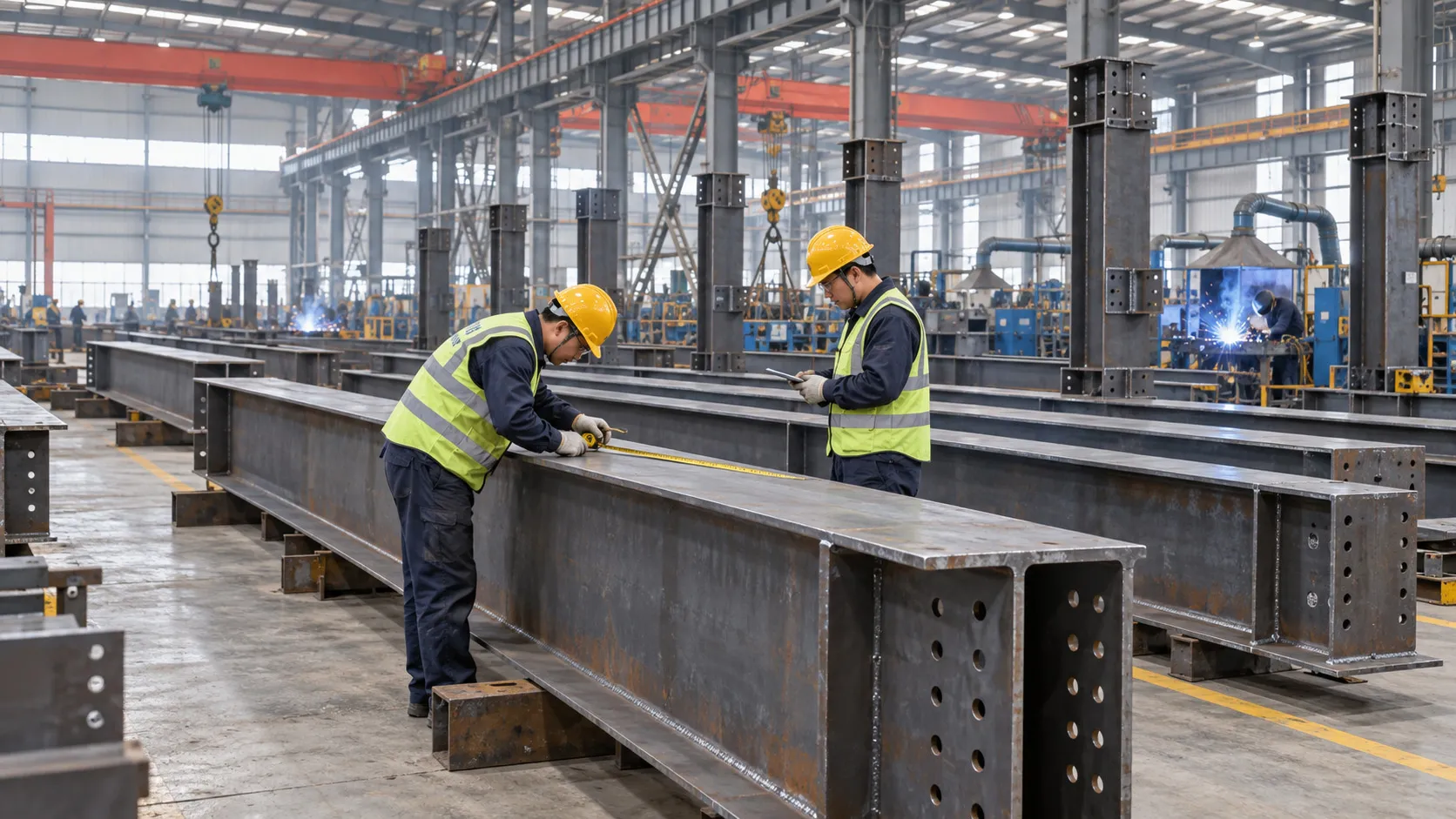
Quality systems among China steel structure manufacturers should be reviewed against the actual project requirements. Buyers should define inspection requirements before placing the order, not after fabrication is nearly complete. A statement such as “strict quality control” is not a substitute for a practical inspection plan.
Depending on project requirements, quality control may cover:
- Incoming material inspection.
- Material identification.
- Cutting and drilling dimensions.
- Fit-up inspection.
- Welding procedures and welder qualifications.
- Visual weld inspection.
- Specified non-destructive testing.
- Overall dimensional inspection.
- Surface preparation.
- Coating thickness.
- Nonconformance and repair control.
- Final release inspection.
ISO 9001 is a recognized quality-management standard, but certification alone does not prove that every project requirement has been satisfied. Buyers should verify the certificate scope and review the actual project-specific quality controls.
For a detailed manufacturing checklist, see our steel structure quality control guide.
8. Control Shop Drawings and Revisions Carefully
Drawing control is especially important in international sourcing because the buyer, engineer and Chinese fabrication team may work in different locations and time zones.
Before production, agree how the manufacturer will control:
- General arrangement drawings.
- Structural calculations where included.
- Shop drawings.
- Connection details.
- Anchor-bolt plans.
- Cladding drawings.
- Erection drawings.
- Customer comments.
- Revision numbers.
- Approved-for-fabrication releases.
Production should use a clearly approved drawing revision. A change sent by email is not useful if the factory floor continues working from an obsolete drawing.
9. Specify Surface Treatment and Cladding in Detail
Two China steel structure manufacturers can quote the same frame while offering very different durability and envelope specifications.
For painted steel, define the required surface preparation and coating system rather than only a paint color. Where galvanizing is specified, confirm the relevant project requirements and component suitability.
Our steel structure surface treatment guide explains blasting, painting and galvanizing options.
For roof and wall systems, compare sheet or sandwich-panel profile, steel thickness, coating, insulation core, panel thickness, fasteners, flashing, gutters and weatherproofing. See our roof and wall cladding systems guide for additional detail.
10. Use Factory Audits and Third-Party Inspection When Project Risk Justifies It
Not every small order requires a full factory audit, but larger or technically demanding projects may justify additional verification.
Buyers can use:
- In-person factory visits.
- Live video factory reviews.
- Independent factory audits.
- Witness points during fabrication.
- Third-party NDT where specified.
- Coating inspection.
- Pre-shipment inspection.
- Container-loading inspection.
The inspection plan should identify who inspects, which standard applies, what records are required and what happens when an item does not conform.
11. Clarify Payment Terms, Change Control and Incoterms
Technical control and commercial control should support each other. Before paying a deposit, the contract should clearly identify the agreed scope, drawings, specifications, payment milestones, delivery basis and change process.
Important commercial points can include:
- Contracting legal entity.
- Quotation validity.
- Deposit and milestone payments.
- What triggers each payment.
- Drawing-approval responsibility.
- Variation or change-order procedure.
- Inspection hold points.
- Production completion definition.
- Shipping responsibility.
- Warranty terms where applicable.
- Handling of shortages or damaged components.
The ICC Incoterms rules define commonly used trade terms that allocate delivery obligations, costs and risks between seller and buyer. The contract should identify the selected term, the named port or place and the applicable version rather than using terms such as “FOB” or “CIF” without a named location.
12. Plan Packing and Shipping with China Steel Structure Manufacturers
Export preparation is one of the most important differences between domestic supply and buying from China steel structure manufacturers for an overseas project. Steel structures are large, heavy and made up of many individually marked components. Export logistics should therefore influence detailing and packing decisions before production is complete.
Buyers should confirm:
- Maximum member length and shipping splits.
- Container or break-bulk strategy.
- Piece-marking system.
- Bundle identification.
- Bolt and accessory packing.
- Protection of painted surfaces.
- Protection of roof and wall panels.
- Container weight distribution.
- Cargo securing.
- Packing lists.
- Loading photographs.
- Shipping documents.
- Unloading requirements at destination.
A low factory price can lose its advantage if components arrive damaged, unidentified or packed in a sequence that makes erection difficult.
Our steel building packing and shipping guide explains member marking, container preparation and overseas delivery in more detail.
Common Red Flags When Sourcing Steel Structures from China
No single issue automatically proves that a supplier is unsuitable, but several warning signs together justify further verification.
- A final price is offered without asking for the project location or design loads.
- The supplier cannot identify the actual fabrication factory.
- Steel grades are described vaguely.
- Important drawing responsibilities are unclear.
- The quotation excludes major components without making the exclusions obvious.
- A large price difference cannot be explained technically.
- The supplier promises an unrealistic production schedule.
- Quality claims are made without explaining inspection procedures.
- Material certificates cannot be linked to production material when traceability is required.
- Required certificates cannot be independently verified.
- Shipping is considered only after fabrication is complete.
- The supplier has no clear process for technical questions after shipment.
A Practical China Steel Structure Sourcing Workflow
The following sequence helps buyers compare China steel structure manufacturers while keeping engineering, procurement and logistics aligned.
- Prepare the project brief. Define use, dimensions, loads, standards, cladding and delivery destination.
- Shortlist manufacturers. Review relevant projects, factory capability and export experience.
- Issue one RFQ revision. Send the same technical package to every bidder.
- Review technical questions. Resolve missing loads, openings, cranes, coatings and interfaces.
- Normalize quotations. Compare the same steel, cladding, accessories, engineering, inspection and freight scope.
- Verify the factory. Use documents, video, audit or site visit as appropriate.
- Agree drawings and quality requirements. Define approval stages, inspections and records before production.
- Approve fabrication. Release the correct drawings and material specifications.
- Monitor manufacturing. Review progress, inspections, NDT and coating records as required.
- Complete pre-shipment review. Confirm quantities, piece marks, packing lists and outstanding issues.
- Control loading and shipping. Verify containers, securing, documents and destination requirements.
- Support erection. Use erection drawings, packing lists and a clear technical communication channel.
Documents Buyers May Request Before Shipment
The required documentation depends on the contract, but an overseas steel structure project may include:
| Document | Purpose |
|---|---|
| Approved drawings | Confirm the final geometry and fabrication basis |
| Material certificates | Document specified material properties where required |
| Welding records | Support welding-procedure and qualification requirements |
| NDT reports | Record specified non-destructive examinations |
| Dimensional reports | Document critical fabrication dimensions where required |
| Coating records | Record surface preparation and coating thickness where specified |
| Packing list | Identify shipped components, bundles and accessories |
| Loading photos | Record cargo condition and container loading |
| Erection drawings | Support identification and site assembly |
| Commercial shipping documents | Support transport, customs and delivery processes |
Sourcing Steel Structures from Bingfa Steel Structure in China
For buyers comparing China steel structure manufacturers, Bingfa Steel Structure is a China-based manufacturer supplying prefabricated steel buildings and industrial steel structures for overseas projects. Our project workflow can include technical review, drawings, steel fabrication, quality inspection, surface treatment, component marking, packing and export preparation according to the agreed scope.
For buyers sourcing a warehouse, workshop, factory or industrial steel structure from China, the most useful first step is to provide the project location, dimensions, application, design requirements, drawings if available and delivery destination.
Looking for China steel structure manufacturers for an overseas project? Contact Bingfa Steel Structure with your project location, building dimensions, application, drawings, crane or equipment requirements and destination port. We can review the information and discuss a project-specific steel structure proposal.
Frequently Asked Questions
How do I find reliable China steel structure manufacturers?
Start with manufacturers that have relevant project experience and can clearly explain their engineering scope, factory capability, material specifications, quality-control process, export packing and technical support. Verify important claims with drawings, certificates, inspection records, factory evidence or third-party checks where appropriate.
What information should I send to a Chinese steel structure manufacturer?
Provide the project location, building use, dimensions, clear height, structural loads, crane or equipment requirements, design standard, cladding specification, surface treatment, drawings if available and delivery destination. A consistent RFQ package makes supplier quotations easier to compare.
How can I tell whether a supplier is a manufacturer or trading company?
Ask which legal entity owns or operates the factory, request the fabrication address, review factory evidence and confirm who controls engineering, material purchasing, welding, inspection and packing. A trading company can still be a valid partner, but the actual manufacturing and quality responsibilities should be transparent.
Should I choose the lowest-price steel structure quotation from China?
Not automatically. Check whether quotations use the same design loads, steel grades, coating, cladding, accessories, inspection requirements, engineering scope, packing and freight basis. A lower price may reflect exclusions or different technical assumptions.
Can China steel structure manufacturers design to AISC or Eurocode requirements?
Some manufacturers can work with multiple structural standards, but capability should be verified for the specific project. The contract should identify the governing code, edition, design loads and approval responsibilities. Local engineer or authority approval may still be required at the destination.
How can I inspect steel fabrication before shipment?
Inspection options include factory visits, video reviews, independent audits, material-document review, welding inspection, specified NDT, dimensional checks, coating inspection, pre-shipment inspection and container-loading inspection. Define the required inspection plan before production begins.
Which Incoterm should I use when buying steel structures from China?
The appropriate Incoterm depends on who will arrange transport, insurance, export formalities and destination delivery. The contract should state the selected Incoterm, the named port or place and the applicable version. Buyers should review the responsibilities associated with the selected term before signing.
How are prefabricated steel buildings shipped from China?
Steel members are typically marked, bundled and prepared for suitable international transport such as containers or other cargo methods depending on member dimensions and project requirements. Packing lists, shipping splits, cargo securing and destination unloading should be planned before shipment.