An industrial steel pipe rack structure is not simply a platform with pipes placed on top. It is a coordinated load-bearing system that must support piping, bandejas de cables, rutas de acceso, cargas de mantenimiento, viento, seismic actions, thermal pipe reactions, and future services without obstructing roads or process equipment.
For owners and EPC contractors, the main risk is an incomplete design basis. A low fabrication price can rise quickly when pipe loads, anchor forces, autorizaciones, protección contra incendios, corrosion category, límites de transporte, or field interfaces are added late.
This product guide explains how to specify and compare an industrial steel pipe rack structure for refineries, plantas quimicas, power facilities, water-treatment plants, food processing sites, mining operations, and other process industries. It focuses on structural configuration, design inputs, fabrication quality, modular delivery, revestimiento, documentation, and total installed value.
What Is an Industrial Steel Pipe Rack Structure?
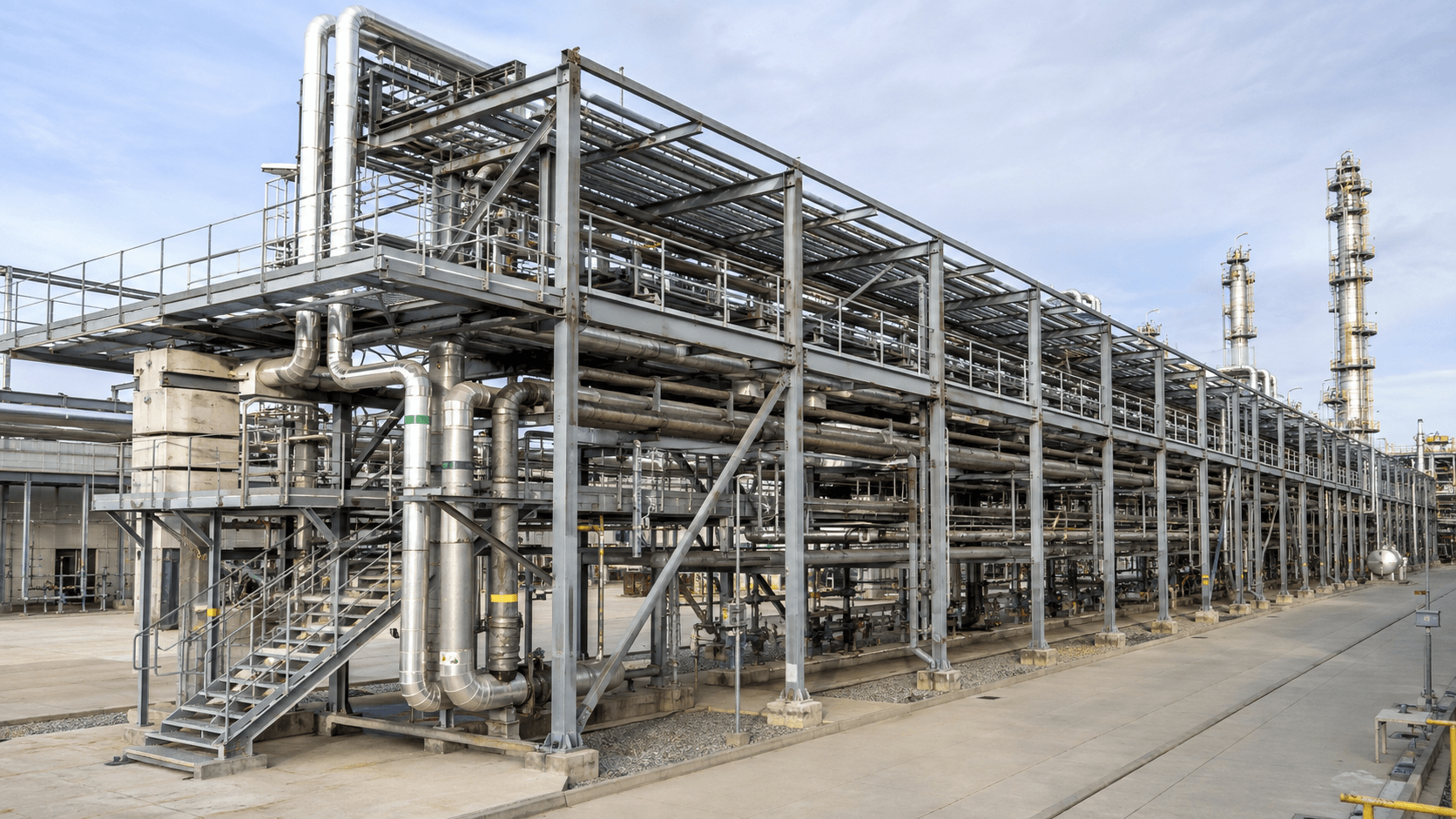
An industrial pipe rack is a steel frame that creates an organized elevated route for process pipes, utility lines, electrical cable trays, instrumentation, and sometimes maintenance walkways. The structure normally consists of transverse frames connected by longitudinal beams and bracing. Pipe-support beams create tiers, while columns transfer gravity and lateral forces to base plates, pernos de anclaje, and foundations.
The rack may be a continuous multi-bay frame, independent bridge, low sleeper rack, or off-site module. It can integrate platforms, valve access, escaleras, monorraíles, iluminación, fireproofing, and future pipe positions.
The steelwork supplier does not determine piping reactions alone. Pipe sizes, contents, operating and test conditions, apoya, guías, anclas, friction, and thermal movement must be developed with the piping and stress-analysis teams. The structural engineer then designs for the agreed load cases.
Where Steel Pipe Racks Are Used
A well-planned industrial steel pipe rack structure separates services from vehicle and pedestrian routes, reduces ground-level congestion, and provides controlled access for inspection. Las aplicaciones comunes incluyen:
- Petrochemical, refinery, chemical, and specialty-chemical facilities.
- Power plants, boiler systems, cooling-water networks, and utility corridors.
- Water and wastewater treatment plants.
- Food, beverage, pharmaceutical, and clean-utility installations.
- Mining, mineral processing, cement, and bulk-material facilities.
- Tank farms, loading terminals, marine facilities, and inter-building pipe bridges.
The arrangement depends on plant layout, acceso, pipe flexibility, exposure, expansion strategy, y secuencia de construcción. Standard bays can improve fabrication efficiency, but final geometry must follow actual pipe and equipment data.
Design Information Buyers Must Provide
Comparable quotations require the same technical inputs. Before asking for a firm proposal, the owner or EPC team should define:
- Site location, governing design standards, vida de diseño, categoría de riesgo, and approval requirements.
- Rack length, ancho, tier elevations, espacio entre bahías, road crossings, altura libre, and future extension zones.
- Pipe line list, operating and hydrotest weights, aislamiento, support spacing, anclas, guías, friction, and thermal reactions.
- Cable-tray layout and loads, maintenance walkways, escaleras, ladders, pasamanos, plataformas, monorraíles, and lifting points.
- Viento, sísmico, nieve, ice, temperatura, accidental, blast, fire, and construction loads where applicable.
- Foundation responsibility, allowable reactions, soil data, grout requirements, and anchor-bolt interface.
- Steel grades, welding code, bolting system, coating or galvanizing specification, fireproofing, inspección, and documentation.
- Shipping limits, module size, lifting philosophy, acceso al sitio, erection sequence, and required completion date.
Industrial steel pipe rack structure projects using U.S. standards may refer to ASCE/SEIS 7-22 for design loads and ANSI/AISC 360 for structural steel. International projects should use the contract standards, editions, national annexes, owner specifications, and authority requirements.
Loads and Structural Behavior
Gravity and Operating Loads
Vacío, operante, flooded, hidroprueba, mantenimiento, and future pipe conditions may produce different controlling reactions. The design should distinguish sustained loads from occasional conditions and identify which lines can be tested simultaneously. Cable trays, walkways, valvulas, aislamiento, fireproofing, and suspended equipment must be included rather than treated as negligible.
Thermal, Anchor, and Friction Forces
Hot or cryogenic piping expands and contracts. Anchors transmit deliberate forces, guides control direction, and sliding supports develop friction. These reactions can govern longitudinal beams, vigorizante, columnas, placas base, and foundations. Assumed friction coefficients and load directions should be documented, and structural deflection limits should remain compatible with piping behavior.
Viento, Seismic, and Accidental Actions
An open rack still attracts wind on pipes, trays, plataformas, and structural members. Seismic mass includes supported systems as defined by the project criteria. Vehicle impact, dropped objects, blast, fire, and differential settlement may also require specific checks. Loads should be applied through a consistent model so that local member design and global stability follow the same design basis.
Pipe Rack Configuration Comparison
| Configuración | Best suited to | Primary advantages | Critical coordination point |
|---|---|---|---|
| Field-erected multi-tier rack | Long permanent process corridors | Flexible bay geometry and easy site adjustment | Site welding, bolting, acceso, and erection sequence |
| Modular pipe rack | Remote sites or projects prioritizing off-site assembly | More work completed under controlled conditions | Transport envelope, levantando peso, module splices |
| Pipe bridge | Road, rail, drenaje, or inter-building crossings | Clear route below with concentrated crossing works | Desviación, autorización, impact protection, erection lift |
| Low sleeper rack | Short runs with limited access below | Lower steel tonnage and simple maintenance access | Drainage, corrosion, crossings, and personnel routes |
| Rack with access platform | Frequent valve or instrument maintenance | Integrated safe access and operating space | carga viva, egress, pasamanos, dropped-object control |
Layout, Clearances, and Future Capacity
Steel pipe rack design begins with the plant layout. Columns should avoid roads, maintenance pull spaces, underground services, drainage channels, and equipment-removal paths. Tier elevations must suit pipe slopes, branch connections, cable segregation, acceso, insulation clearance, and crossings. Walkways need usable width after pipes, valvulas, and supports are installed.
Future capacity should be defined as actual reserved line positions and design loads, not a general percentage added without location. El industrial steel pipe rack structure may need empty support zones, stronger selected beams, planned module extensions, spare cable-tray brackets, or connection plates for future platforms. Those provisions should appear on drawings and in the calculation model.
Serviceability is as important as strength. Excessive vertical deflection can disturb drainage or pipe slope, while lateral movement can affect expansion joints and equipment nozzles. Tolerances between fabricated steel, cimientos, pipe spools, and equipment interfaces require agreement before production.
Materiales, Conexiones, and Fabrication
Common primary members include hot-rolled I-sections, welded built-up sections, hollow structural sections, channels, and angles. The best choice depends on loads, acceso a la conexión, local availability, fireproofing, revestimiento, transporte, and owner preferences. Open sections are generally easier to inspect and connect; hollow sections can reduce exposed surface area but require sealed or vented details appropriate to the coating process.
Bolted field splices support predictable modular erection and reduce site welding. Shop welding can improve control when qualified procedures, consumables, welders, inspección, and repair methods are defined. When AWS practice is specified, AWS D1.1/D1.1M:2025 addresses structural-steel welding qualification, servicios de fabricación, inspección, and acceptance. Other projects may specify ISO, EN, GB, AS/NZS, or owner welding requirements.
Connection detailing should allow bolt installation, inspección, coating repair, pipe-support attachment, and field tolerances. Avoid unapproved drilling or welding after coating. Nuestro proceso de fabricación de acero estructural guide explains cutting, perforación, asamblea, soldadura, preparación de la superficie, revestimiento, final inspection, and marking controls.
Corrosion Protection and Fire Requirements
Coating selection should reflect the real exposure: inland, coastal, chemical, high-humidity, lavado, insulated, or fireproofed zones. Surface preparation, revestimiento de rayas, espesor de película seca, edge treatment, repair procedures, access for inspection, and compatibility with fireproofing all influence service life.
ISO 12944-5 provides guidance on protective paint systems for different environments and preparation grades. Hot-dip galvanizing may suit many outdoor secondary members, escaleras, and gratings, while large frames are often painted or metallized depending on project requirements and bath limitations. Compare these options in our guide to tratamiento superficial de la estructura de acero.
Passive fire protection is project-specific. Required fire resistance may depend on process hazards, escalation studies, emergency response, and the consequence of structural failure. Steel geometry, clips, mesh, primers, drainage details, and inspection access must be coordinated with the selected system.
Modular Fabrication, Envío, and Erection
Modular pipe rack fabrication can reduce congested site work by combining steel, pipe supports, gratings, trays, and sometimes piping into transportable assemblies. The economic module size is controlled by road or port limits, capacidad de levantamiento, centro de gravedad, refuerzo temporal, shipping supports, and the ability to make final connections safely.
A good module is designed for permanent loads and temporary conditions. Lifting lugs, transport restraints, removable bracing, splice access, survey points, and erection tolerances should be engineered. Trial assembly may be justified for complicated interfaces. Piece marks and module identification must match packing lists and erection drawings.
Field sequencing should protect stability at every stage. Foundations and anchor bolts are surveyed before delivery; columns and frames are erected with temporary bracing; permanent bracing is completed before supported systems are released; and coating damage is repaired. Our review of Errores en la instalación de estructuras de acero. highlights risks such as premature brace removal and uncontrolled field modification.
Quality Control and Deliverables
An industrial steel pipe rack structure supplier should use approved drawings and inspection plans from material receipt through dispatch. Typical hold points include material identification, dimensiones, fit-up, soldadura, NDT, asamblea de prueba, preparación de la superficie, coating thickness, and final release.
The document package may include material certificates, welding procedure and welder qualifications, informes de inspección, NDT records, informes dimensionales, coating batch data, surface-preparation and thickness records, calibration certificates, bolt certificates, nonconformance closeout, listas de embalaje, erection drawings, and as-built revisions. Required formats and language should be agreed before award.
What Affects Pipe Rack Cost and Schedule?
Steel weight is not the only cost driver. Height, tiers, durar, heavy anchors, plataformas, fireproofing, modularización, conexiones, steel grade, inspección, revestimiento, asamblea de prueba, and documentation can change the price substantially.
Late piping reactions and changing line layouts create schedule risk. Beams and connections cannot be finalized while anchor forces or support locations remain provisional. Set information-release dates and a process for later changes.
For an industrial steel pipe rack structure, compare delivered scope rather than price per tonne. Freight, shipping frames, embalaje de exportación, site welding, coating repair, grúas, supervision, and foundation interfaces may be outside a basic fabrication quote.
How to Compare Industrial Pipe Rack Suppliers
A capable industrial steel pipe rack structure supplier should demonstrate coordination experience with structural, piping, civil, eléctrico, and construction disciplines. Ask for a clear responsibility matrix, design assumptions, calculation scope, model and drawing deliverables, connection responsibility, plan de inspección, coating procedure, método de embalaje, and erection support.
Review exclusions carefully. Confirm whether the proposal covers foundations, anclas, pipe shoes, slide plates, plataformas, escaleras, tray supports, fireproofing attachments, lifting lugs, transport bracing, pernos, gratings, pasamanos, and touch-up materials. A complete offer improves comparison and reduces variations.
A Coordinated Pipe Rack Protects the Whole Project
An industrial steel pipe rack structure succeeds when piping loads, structural behavior, acceso, protección contra la corrosión, servicios de fabricación, transporte, and erection are treated as one coordinated system. Early definition of reactions and interfaces prevents unnecessary steel, late reinforcement, field rework, and schedule disruption.
The best procurement decision is therefore based on verified scope, engineering capability, quality records, and installed value—not only the lowest steel price.
Preguntas frecuentes
What information is required to quote an industrial steel pipe rack structure?
Provide the general arrangement, rack dimensions, tier levels, espacio entre bahías, pipe and cable loads, thermal and anchor reactions, requisitos de acceso, site conditions, design standards, steel grades, coating or galvanizing specification, inspection scope, shipping limits, and delivery location. Preliminary estimates can use assumptions, but a firm quotation needs controlled input data.
What span and height can a steel pipe rack use?
There is no universal maximum. Span and height depend on supported loads, deflection limits, road or equipment clearance, member availability, vigorizante, cimientos, transporte, and economics. Longer crossings may use trusses or deeper girders, while regular process corridors typically use repeated bays selected through project-specific engineering.
Should a pipe rack be painted or hot-dip galvanized?
Both can be suitable. Paint systems offer broad specification flexibility and are practical for large frames. Galvanizing provides factory-applied zinc protection but requires suitable member size, venting, drenaje, distortion control, and compatible field-repair details. Exposure, vida de diseño, fireproofing, acceso de mantenimiento, and local capability should guide selection.
Can pipe racks be supplied as modular sections?
Sí. Steel frames can be shipped as loose members, preassembled frames, or larger modules with gratings, apoya, trays, and selected piping. Transport dimensions, levantando peso, estabilidad temporal, acceso a la conexión, and route restrictions determine the practical level of modularization.
What documents are provided with fabricated pipe rack steelwork?
The agreed package commonly includes approved shop drawings, certificados de materiales, welding qualifications, inspection and NDT reports, dimensional records, coating reports, bolt data, listas de embalaje, erection drawings, and release documentation. Project specifications should state every required document and approval point before fabrication begins.