Share This :
Advantages and Disadvantages of Steel Structure Buildings
advantages and disadvantages of steel structure buildings
Steel has been supporting buildings (such as skyscrapers), warehouses and bridges for more than 100 years, and the amount of steel used in construction continues to increase. In 2026, due to the increased demand for quicker construction times and more earth friendly products, steel framing is now being used for an ever increasing percentage of commercial/industrial projects being constructed worldwide. However, selecting a Structural System can be quite difficult due to all of the advantages and disadvantages of each material (including steel).
It’s very important for Your project, whatever that might be (a one-story storefront or a ten-story business building) know about what are pros and cons of having steel frame building. Steel can provide months of speed to your construction while giving architects an ability to produce wide open spaces inside of your building. However, steel also presents problems with fire resistance, corrosion, and also fluctuating material costs. Your choice should depend on factors such as your climate, your budget, your expected use for the building, and the long term maintenance plan you have for the building.
Understanding the advantages and disadvantages of steel structure buildings helps buyers make better decisions before starting a project.
This is not a matter of “concrete is bad, steel is good”. There are actually many aspects and layers to this discussion that most people overlook when thinking about the specific type of product they wish to use (Concrete or Steel). We’re providing an honest look at the advantages and disadvantages that Steel products provide to Modern Construction.
The Primary Advantage of Using Steel in Commercial / Industrial Construction.
There are many reasons why steel has become the most popular type of building product in the commercial and Industrial Construction Sectors. Steel provides a solution to many of the struggles of other types of building material related to the speed at which we can build, the span of our finished product and the overall building’s structural performance.
The Strength to Weight Ratio of Steel is Superior
Pound for pound, structural steel is among the strongest types of material used in construction. For example, a steel beam can carry the same load as a concrete beam weighing 4 to 5 times more than it. This has significant implications for foundation design; lighter superstructures = less expensive and much smaller foundations. This can result in significant cost savings on sites with poor soil or high-water table conditions.
A structural steel building will generally weigh about a third to a fourth less than a similar concrete structure. This will free up approximately one-fifth of the floor area in the building per floor, which means that it results in more usable floor area for the building owner. Free space translates directly into additional square footage that increases the building owner’s revenue.
The advantages and disadvantages of steel structure buildings depend on project use, climate conditions, budget, and building design requirements.
Speed of Prefabrication and Assembly
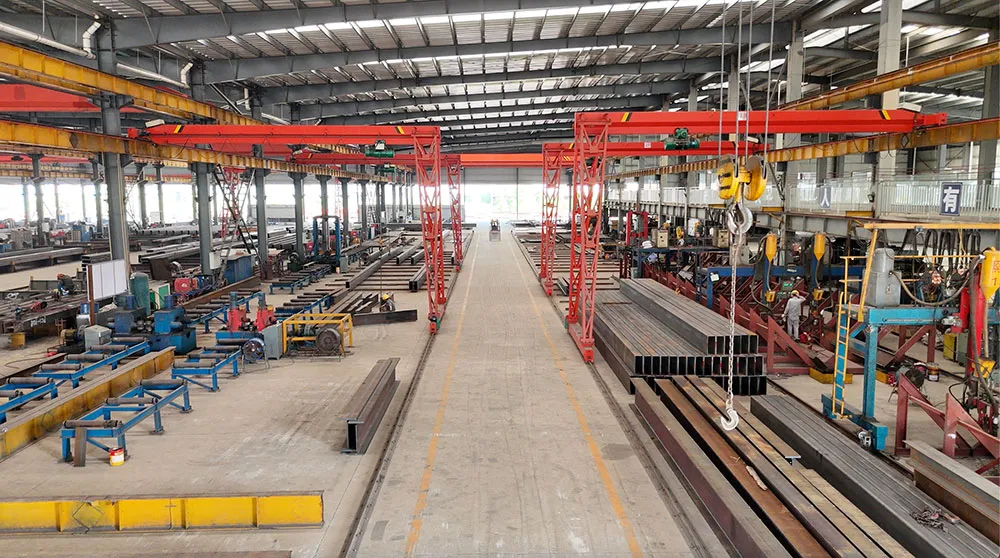
Steel parts are fabricated in controlled environments and then transported to the construction site for assembly. This method of prefabrication tactic dramatically shortens project timelines. Steel framed commercial buildings can be built approximately 30 to 40% faster than those made of concrete due to the fact that the steel does not need to be cured like concrete. The construction of a steel frame can take place at any time since there is no reliance on weather conditions for pouring concrete.
Speed is Money. Shorter construction time translates into less labour cost, fewer financing charges, and occupancy. For a developer, opening three months sooner could mean an additional hundreds of thousands of dollars in rent. Factory fabrication precision also minimizes on-site waste and rework which helps keep the project costs within budget.
Design Flexibility and Long Span Capabilities
There is a reason why architects use steel so often; it provides an opportunity to create long columns free areas that other materials simply cannot create, without being extremely deep structurally. With a steel truss, you can create a 60m spacethat can be used for large convention centers, airplane hangers, sporting arenas or large distribution warehousesand be totally open inside.
This agility applies to renovations as well as future changes. It is relatively easy to expand steel structures horizontally and vertically. Compared to altering a load-bearing masonry (brick/stucco) or concrete building, creating new openings, adding a mezzanine, or reinforcing to support greater loads, is relatively easy. There is substantial economic value in flexibility to building owners who expect their needs to change over time (next 20-30 years).
“Sustainability and Long-Term Durability”
Steel has seen its environmental performance improve drastically in recent years, with two decades of better products being produced and longer service lives providing steel an environmental advantage over all organic materials used in construction.
Recyclability and Environmental Impact
The most recycled material in the world is steel. The World Steel Association reports that more than eighty-five percent of all structural steel is recycled when a building reaches the end of its useful life, and it takes about seventy-four percent less energy to manufacture recycled steel than it does to produce virgin steel from iron ore. Most steel producers today are producing structural steel with probably more than 90% recycled content.
However, producing steel primarily still has a high carbon footprint, and the steel manufacturing industry generates about 7–8% of global carbon dioxide emissions. Electric arc furnace technologies (which use scrap metal) produce cleaner steel than do the more traditional blast furnace processes; electric arc furnaces are increasing their share of the market every day. By 2026 several large steel manufacturers will have near zero carbon steel production targets for the following ten years. Even though this may be moving in a positive direction, environmentally there is still a good bit of impact today.
Pest Resistance, Mold Resistance, and Decay Resistance.
Steel doesn’t rot, warp or attract termites unlike wood framing. Steel has major practical benefit in humid climates or flood-prone areas. A steel-framed building in coastal Florida or Southeast Asia will not suffer structural degradation that plagues timber construction in these environments.
In addition, fact steel is very stable in its dimensions. Unlike wood, which shrinks or expands as moisture levels change, steel does not do so. That means there will be no finished cracks, door/window operations will remain uniform and there will be less frequent maintenance because of structural movement over time. The dimensional stability of steel is essential for buildings that are expected to last for more than 50 years (for example, institutions).
Main Drawbacks/Technical Constraints.
It is important to remember that steel has many true disadvantages for which the designer must find solutions and must account for the time and money it takes to correct those issues. If not addressed, they cause many problems and significant costs later on.
Corrosion and Oxidation Potential
Steel will corrode, just as water will rust. The cross-sectional area of steel and its load-carrying capacity will decrease due to the exposure of unprotected steel to moisture and oxygen. Corrosion is an ongoing concern in the marine environment, in industrial locations that have chemical exposure, or locations that experience large amounts of rain.
The protective measures involved galvanizing, painting or applying a special type of coating to shield the steel; however, none provides permanent protection. It is therefore important that the protective coatings are regularly checked and maintained, usually between 10 and 20 years, depending on the surrounding environment. Weathering steel (commonly referred to as Corten) forms a very tough rust-like layer that slows down further corrosion but it is not suitable for every application and it will not completely eliminate corrosion. A steel structure requires constant monitoring of corrosion, i.e., throughout its entire life.
High thermal conductivity and energy loss
Steel is 1,000 times better than concrete in conducting heat, and it is 2,500 times better than wood. If no proper thermal breaks are provided, steel forms a direct path for heat through the walls and roof, resulting in higher heating and cooling costs.
The problem with thermal bridging is that it causes serious issues in cold climates. In cold climate areas, a steel wall thats built with steel studs but has no thermal breaks will lose 30% to 50% of its insulation value (R-value). There are solutions to address this issue including insulated cladding systems, continuous exterior insulation, and thermal break pads, but these add to the cost and complexity of the building envelope design. Not considering the thermal performance when designing is one of the most common mistakes that is also one of the costliest mistakes made in steel construction.
High Temperature Structural Weakness
Here’s an amazing truth: steel loses approximately 50% of its structural integrity at temperatures of approximately 600 degrees Celsius (approx 1100 degrees Fahrenheit). In the case of a building fire, if the steel components are not protected, they can deform and fail, causing the structure to collapse, in a very short period of time typically 15 – 30 min. In contrast, wood can become charred on the outside but maintain its structural integrity longer during several types of fire.
The majority of building codes specifies that steel must be protected against fire. Some of the options available to fireproof steel include applying an intumescent paint (which when heated expands and creates a new insulating layer), using spray-applied fireproofing, or encasing the steel in concrete or gypsum board. While these measures are very effective in providing fire protection, they do require additional materials, labor costs, and installation time. In fact, in certain types of projects, just adding fire protection can often add between 5-10% to the cost of the structural frame.
The overall costs of constructing with steel have many more variables than simply comparing the cost per ton of steel. To fully understand the costs of a structure you must examine all Costs, including Labor, Schedule (Time), and the associated maintenance as well as the market conditions at any given time
Material Costs vs. Labor Savings Associated with Construction.
The prices of raw steel are among the most volatile commodities, with prices of hot rolled coil swinging from below $500 per ton to above $1,900 per ton and back again in the period between 2020 and 2026. Because of the price volatility of raw steel, it is difficult to budget for raw steel costs in a project, and projects that have longer lead times between design and procurement are subject to a considerable risk of cost escalation.
Part of the reason why the cost bar gets rebalanced between steel and concrete is the faster construction time steel provides. The less time required for labor on-site, the less money will be spent building the project; less labour time spent on formwork; less supervision time required on site. All of these factors make using steel often equal to, if not less expensive than concrete when you look at the total cost of constructing a project. The “math” certainly differs depending on region, project size, and local labour costs. In general, prefabrication of steel in areas with high labour rates gives an even greater advantage to steel.
Maintenance Requirements/Potential Life Cycle Expenses.
The upfront price of a steel building is just a “beginning” of the “entire story.” The cost of maintaining the structure (including the cost of inspecting the building for corrosion protection or fireproofing) will have a major long-term impact on the overall cost of the building. In general, you should expect to incur costs every five years for coating inspections, while you should expect to incur costs to repaint or recoat the building every fifteen to twenty years in moderate climates, or more frequently in environments that are very humid, very dry, or have high levels of ultraviolet light.
In addition to the positive aspects of steel, most of the steel buildings require very little of the type of structural repairs that concrete buildings of an older age would require. In an aging reinforced concrete structure, repairing spalling of the concrete, corrosion of the reinforcing steel, and repairing concaceous cracks will be very costly. Steel maintenance costs, although not insignificant, are relatively predictable and can be planned for.
Choosing the correct structure for a given application.
When choosing between steel and any other material to construct your building, there are many factors that should all be considered before making your final decision. The needs of a warehouse located in a very dry climate can be quite different from those of a hospital located near the coast or a residential high-rise tower.
Steel provides high strength, making it perfect for larger spans within commercial and industrial structures and high-rise types of construction. Steel is extremely flexible when needed for speed, and its ductility makes it an option of choice for applications in seismic zones. When steel flexes, it aborbs the energy from an earthquake rather than stiff materials that crack.
Concrete-based systems, in addition to hybrid systems, could be an optimal choice for buildings that require high levels of thermal mass along with fire resistance and acoustic separation between adjacent floors. Most residential construction projects are built with wood or light-gauge steel frame, especially when they are low-rise (for cost considerations).
When looking at what sort of steel building to build, you’ll want to look at the trade-offs: the strength and speed of erection on one end versus the vulnerability to corrosion and fire on the other. Talk to a structural engineer early on in your design process; Talk to your structural engineer before making a decision on your material system. The choice of steel is going to be both Advantages and Disadvantages, and all of your choices will be relative to your project site (conditions), budget (costs) and your intended use (performance).
The fact that you personally like a specific material shouldn’t be a reason to use it on it’s own when your project could benefit from a more thorough analysis of materials based on your project requirements. A good craftsmen/contractor builds with the appropriate materials based upon the specific needs of the job.
For more general information about steel and its role in construction, you can also refer to the World Steel Association.