Author:David Ran
This article discusses steel building components, fabrication, and project planning. Project-specific technical requirements should be confirmed during engineering review.
Share This :
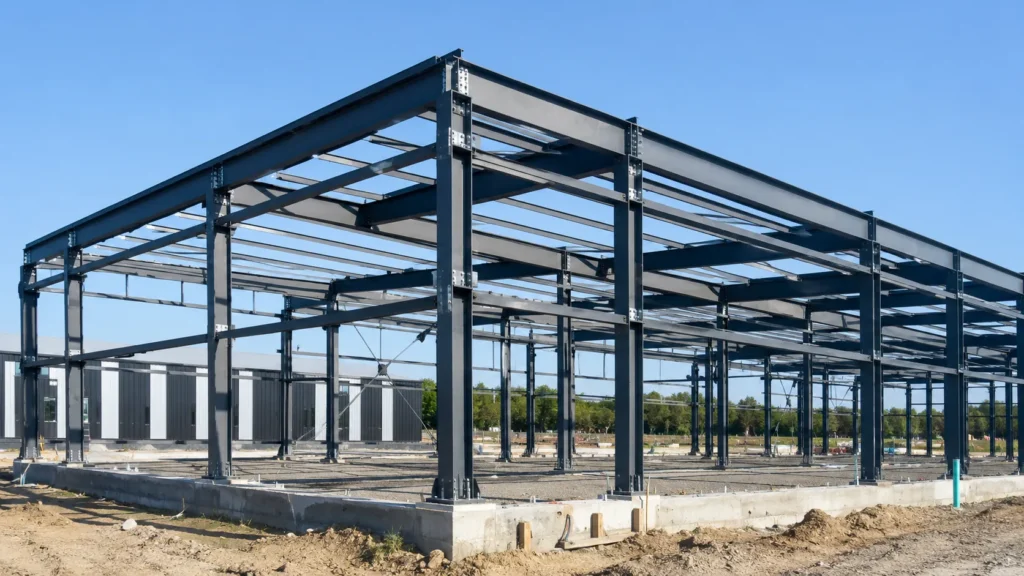
What is structural steel? Structural steel is a type of steel designed for load-bearing construction, including beams, columns, trusses, frames, and other building components. It is widely used in steel structure buildings because of its high strength, reliable performance, and flexible design options.
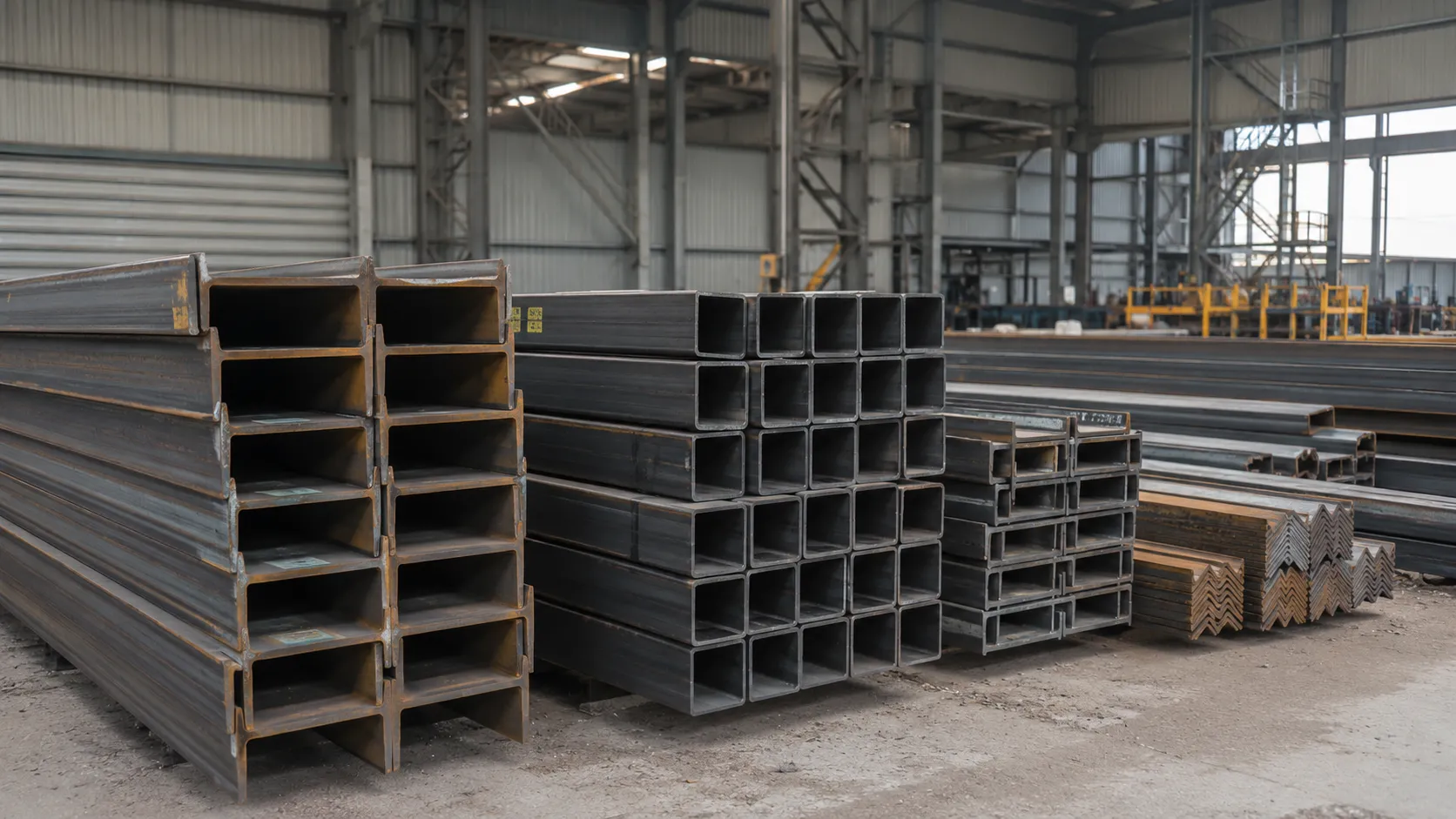
Every building, bridge, and warehouse you walk past relies on a material most people never think about. Structural steel forms the skeleton of modern construction, carrying loads that concrete and timber simply can’t handle on their own. Yet if you ask most people what structural steel actually is, or how one grade differs from another, you’ll get a blank stare. Understanding the materials, grades, and standards behind structural steel matters whether you’re an engineering student, a project manager reviewing specs, or a fabricator choosing between two mill certificates.
The differences between a basic A36 beam and a high-strength low-alloy section can affect project cost, safety margins, and long-term durability in ways that ripple through an entire structure’s lifespan. This is practical knowledge, not academic trivia. Getting the grade or standard wrong doesn’t just mean a failed inspection: it can mean a failed structure. So here’s a clear breakdown of what structural steel is, what it’s made of, how its grades work, and which standards govern it all.
Defining Structural Steel and Its Core Composition
Structural steel is a category of steel shaped and chemically composed specifically for use in construction. It differs from tool steel, stainless steel, or rebar in both its chemistry and its intended load-bearing function. The defining feature is a balance between strength, formability, and cost that makes it suitable for beams, columns, trusses, and frames.
At its simplest, structural steel is an alloy of iron and carbon, with small percentages of other elements added to fine-tune its behavior. The iron provides the base structure, while carbon and alloying elements determine how hard, strong, or ductile the final product will be.
The Role of Carbon Content
Carbon is the single most influential element in steel. Even tiny changes in carbon percentage produce dramatic shifts in mechanical properties. Most structural steels contain between 0.15% and 0.30% carbon by weight, which classifies them as low-to-medium carbon steels.
Higher carbon content increases hardness and tensile strength but reduces ductility and weldability. That tradeoff is why structural steels stay in the low carbon range: you need a material that can flex slightly under load without cracking, and that welders can join on-site without exotic procedures. Push the carbon above 0.30%, and you start needing preheat treatments and special electrodes, which drives up labor costs and slows construction schedules.
Common Alloying Elements
Beyond carbon, several elements appear in structural steel recipes. Manganese (typically 0.50% to 1.65%) improves strength and hardenability while counteracting the brittleness that sulfur can cause. Silicon (0.15% to 0.40%) acts as a deoxidizer during steelmaking and adds modest strength.
Chromium, nickel, copper, and vanadium show up in specialty grades. Copper at around 0.20% to 0.40% gives weathering steels their characteristic rust-colored patina that protects against further corrosion. Vanadium and niobium, even in fractions of a percent, refine the grain structure and boost yield strength without hurting weldability. Each element is a deliberate choice by metallurgists, not a random impurity.
Key Mechanical Properties and Performance Characteristics
Choosing a steel grade without understanding its mechanical properties is like buying a car based only on color. The numbers on a mill certificate tell you how that steel will actually perform under stress, heat, and fatigue.
Yield Strength vs. Tensile Strength
These two values appear on every structural steel specification, and confusing them is a common mistake. Yield strength is the stress at which steel begins to deform permanently. Below that threshold, the material springs back to its original shape. Tensile strength is the maximum stress the steel can withstand before it fractures.
For A36 steel, yield strength sits at a minimum of 36 ksi (250 MPa), while tensile strength ranges from 58 to 80 ksi. Engineers design structures so that loads stay well below yield strength, applying safety factors that vary by code and application. The gap between yield and tensile strength is actually a safety buffer: it represents the zone where the steel deforms visibly before failure, giving occupants warning that something is wrong.
Ductility and Weldability
Ductility measures how much a steel can stretch before breaking, typically expressed as percent elongation in a tensile test. Structural steels generally show 20% or more elongation in an 8-inch gauge length, which is critical for earthquake resistance and impact absorption.
Weldability is harder to quantify with a single number. Engineers often use the carbon equivalent formula (CE), which accounts for carbon plus fractions of manganese, chromium, molybdenum, and other elements. A CE below 0.40 generally means the steel welds easily with standard procedures. Above 0.50, you’re looking at preheat requirements and controlled cooling. Most common structural grades keep CE comfortably below 0.45.
Common Structural Steel Grades
Steel grades are not interchangeable. Each one is designed for specific loading conditions, environments, and fabrication methods. Picking the right grade saves money and prevents overengineering or, worse, under-specifying.
Carbon Steel Grades (A36, A53)
ASTM A36 is the workhorse of structural steel in North America. With a minimum yield strength of 36 ksi, it covers a huge range of applications: building frames, bridges, platforms, and general fabrication. It’s inexpensive, widely available, and easy to weld and machine.
ASTM A53 covers pipe used in structural and pressure applications. It comes in Types E (electric-resistance welded) and S (seamless), with Grade B being the most common. You’ll find A53 pipe in fence posts, bollards, and structural columns where round sections make sense.
High-Strength Low-Alloy (HSLA) Grades
When A36 isn’t strong enough, HSLA grades step in. ASTM A572 Grade 50, with a 50 ksi minimum yield strength, has become the default for most new structural work in the U.S. because it offers roughly 40% more strength than A36 at only a modest cost premium.
ASTM A992 is the standard for wide-flange shapes (W-shapes) and has largely replaced A36 for rolled beams and columns. It specifies a maximum yield-to-tensile ratio of 0.85, ensuring adequate ductility. A588 covers weathering HSLA steels with 50 ksi yield strength, combining corrosion resistance with higher load capacity.
Corrosion-Resistant and Weathering Steels
Weathering steels, often sold under the brand name Cor-Ten, form a stable oxide layer that protects against further atmospheric corrosion. ASTM A588 and A847 are the primary specifications. These steels work best in environments with wet-dry cycling: the patina needs periodic drying to stabilize.
They’re popular for exposed bridges, architectural facades, and outdoor sculptures. However, they’re not a universal solution. In coastal environments with high chloride exposure, or in areas where the steel stays constantly wet, the protective layer doesn’t form properly, and conventional coated steel performs better.
Global Standards and Regulatory Frameworks
Steel produced in Germany, India, or Brazil doesn’t follow the same specification system as steel from a U.S. mill. Understanding the major standards frameworks prevents costly procurement mistakes and ensures compliance.
ASTM International Standards
ASTM (American Society for Testing and Materials) dominates structural steel specification in North America. Key standards include A36, A572, A992, A500 (for HSS), and A588. Each standard defines chemical composition limits, mechanical property minimums, testing methods, and marking requirements.
ASTM standards are referenced directly by the AISC (American Institute of Steel Construction) Steel Construction Manual, which is the primary design reference for structural engineers in the U.S. When a set of drawings calls out “A992 Grade 50,” every mill, fabricator, and inspector knows exactly what chemistry and strength to expect.
European (EN) and International (ISO) Norms
Europe uses the EN 10025 series for hot-rolled structural steels. The grade designation system differs from ASTM: S275JR, for example, indicates a structural steel with 275 MPa minimum yield strength and JR impact toughness at room temperature. S355 is the European rough equivalent of ASTM A572 Grade 50.
ISO standards provide a global framework, with ISO 630 covering general-purpose structural steels. In practice, most countries either adopt EN or ASTM standards directly or maintain national standards that closely mirror one of these two systems. Cross-referencing between systems is common in international projects, and tools like EN-ASTM comparison tables are standard in procurement offices handling global supply chains.
Standard Shapes and Structural Applications
Raw steel doesn’t arrive at a job site as a shapeless slab. Mills roll it into standardized cross-sections, each designed for specific structural roles.
I-Beams, Channels, and Angles
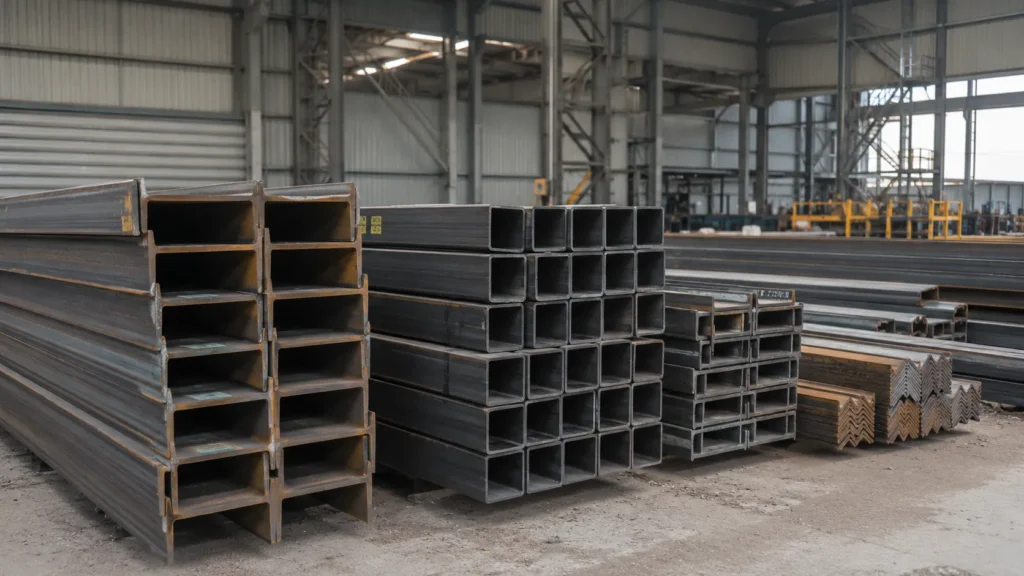
Wide-flange beams (W-shapes) are the most recognizable structural steel product. Their I-shaped cross-section efficiently resists bending, making them ideal for floor beams, girders, and columns. The AISC Steel Construction Manual catalogs hundreds of W-shapes, from the compact W6x9 to the massive W44x335.
C-channels handle lighter loads and work well as framing members, stair stringers, and bracing. Angles (L-shapes) connect other members, serve as lintels above openings, and form truss components. Each shape has published section properties: moment of inertia, section modulus, radius of gyration: that engineers plug directly into design calculations.
Hollow Structural Sections (HSS)
HSS members are square, rectangular, or round tubes. They excel in columns because their closed shape resists buckling equally in all directions, unlike open shapes that have weak axes. ASTM A500 Grade C (50 ksi yield) is the standard specification for formed HSS in the U.S.
Architects favor HSS for exposed structures because the clean lines look better than open sections. You’ll see them in canopies, pedestrian bridges, and modern commercial buildings where the structure doubles as an aesthetic element. Round HSS also appears in truss systems, particularly for long-span roofs in arenas and airports.
Sustainability and the Future of Structural Steel
Steel is one of the most recycled materials on earth. In 2026, the recycling rate for structural steel in North America exceeds 98%, and electric arc furnace (EAF) mills that melt scrap now produce over 70% of domestic steel. That shift from blast furnace to EAF production has cut the carbon footprint of a typical steel beam by roughly 50% compared to two decades ago.
The industry is pushing further. Green steel initiatives using hydrogen as a reducing agent instead of coal are scaling up in Europe and beginning pilot operations in the U.S. EPDs (Environmental Product Declarations) are now standard for major mill products, giving specifiers transparent data on embodied carbon. Some project teams are already achieving 30% to 40% reductions in structural embodied carbon by choosing high-recycled-content steel and optimizing member sizes through advanced analysis software.
For anyone specifying or working with structural steel, the fundamentals covered here: composition, mechanical properties, grades, and governing standards: form the baseline knowledge you need to make smart decisions. The material itself keeps evolving, but the principles behind selecting the right grade for the right application haven’t changed. Know your carbon content, match your grade to the load and environment, and verify that every piece of steel on your project meets the applicable standard. That’s how good structures get built.
For steel structure projects, design quality and fabrication standards are just as important as material selection. Many international buyers also refer to resources from the American Institute of Steel Construction (AISC) to better understand structural steel design, construction practices, and industry standards.